General information and warnings
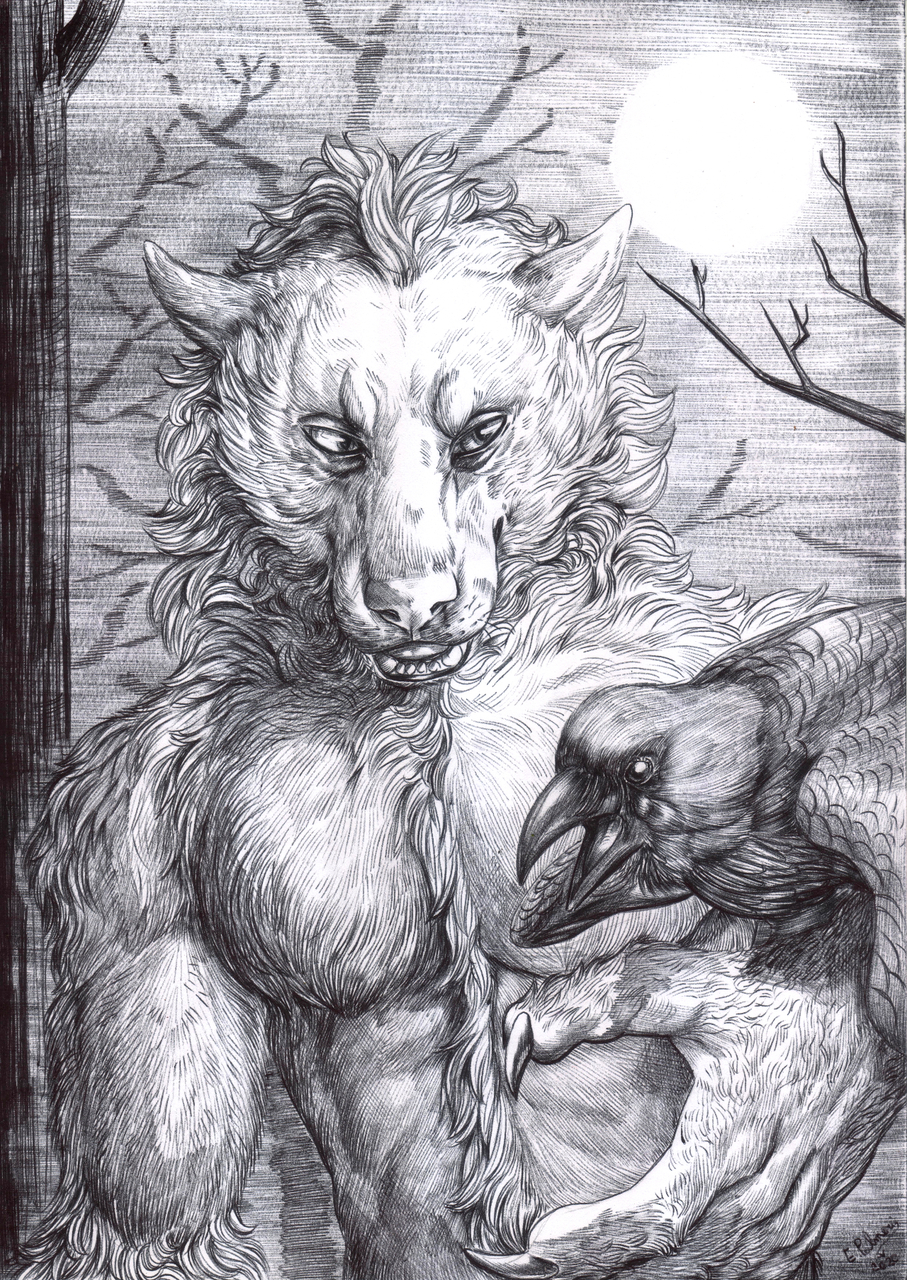
Also known as Goldenwolfen, the Aurolupus are a kind of canine/primate shapeshifters very often confused with the real lycans (Homolupus homolupus) or with the werewolves (Lupus hominarium), but capable of hybridizing with both. They are extremely rare and dangerous, therefore it is advisable not to approach one (in particular if you do not have experience with lycans or werewolves) and, if you encounter them in your zone, to denounce their presence to the competent authorities.
A reminder for the magic users, that these creatures are completely immune to magic both outside and inside their body and therefore that your powers, however developed, can't in any way kill them nor retain them. Due to their incredible bone and muscle density, bullets too may not be decisive in their killing.
Origins
The most probable ancestor of aurolupus beasts is the Xenocyon Lycaonoides, a large canid that lived in the Pleistocene, between 1.8 million years and 30,000 years ago, which feed on antelopes, deers, elephants, wild horses and probably also men.
It is assumed that the Xenocyon have crossed with a primitive "prototype" of lycanthrope and thus acquired the ability to change, albeit in a rough way.
Over time, the aurolupus has refined its mutation skills, although modernly they still do not love to acquire and maintain a humanoid form.
According to some scholars that specialize in the study of this primitive species of shapeshifters, the fairer fur that some specimens show is the result of the interbreeding with the extinct species of lycans known as white terror (Homolupus terribilis), from which modern aurolupuses have inherited not only some shades of their fur, but apparently also greater mental instability and greater aggression than that of their Xenocion ancestors.
Another species that seems to have contributed to the creation of the modern genetic heritage of the aurolupus is the unfortunately recently extinct small African werewolf (Lupus hominarium africanus), from which it seems that they inherited the ability to be totally refractory to all kinds of magic.
However, some researchers argue that the aurolupus have become refractory to magic at the beginning of their evolution due to a spontaneous genetic mutation and not because of the intersection with the small African werewolf.
The first complete standard of the species and its breeds was officially established by the CPF (Company for the protection of the forms) on 18 December 1898 and was reworked again and catalogued in 1980.
Appearance
General characters: the aurolupus or goldenwolfen is shapeshifter werewolf-type of medium-large size, with light fur, strong and muscular, heavy skeleton and solid structure.
Everything in their figure must give an idea of rough strength and must strike fear in the heart of the enemies. The ears are erected.
It is distinct in three different types: supergoldenwolfen (giant), goldenwolfen (medium) and splinter (small).
The most common and functional type is the goldenwolfen (medium), the smallest and more rare are the splinters, while the supergoldenwolfen are considered practically legendary.
Fundamental measures
the aurolupus has four different forms of transformation, in order of height to the shoulder: feral, native, human and fullmoon.
Supergoldenwolfen (giant size)
Feral (lupine type): prefer the females between 70 and 88 centimeters at the withers, males between 71 and 93 centimeters at the withers. The minimum required height is 70 centimeters, there is no maximum height.
Native (hyena/wolf of caves-like type): preferred height for females between 89 and 150 centimeters at the withers, preferred height for males between 94 and 160 centimeters at the withers. Interestingly, in the aurolupus supergoldenwolfen, the native form can grow at much greater heights, but only temporarily, depending on how much they have nourished before their transformation.
Human (humanoid type): minimum height of 1.85 m, maximum of 2.22 m for both males and females.
Fullmoon (anthropomorphic body, covered in fur type): minimum height of 1.90 m and maximum of 2.50, both for males and females. A margin of -2 centimeters is tolerated for females with optimal proportions and +2 centimeters for males that display optimal proportions.
 |
A blind supergoldenwolfen male in native form
|
Goldenwolfen (medium size)
Feral (lupine type): females between 63 and 72 centimeters at the withers, males between 63 and 74 centimeters at the withers.
Native (hyena/wolf of caves-like type): preferred height for females between 89 and 120 centimeters at the withers, preferred height for males between 90 and 140 centimeters at the withers.
Human (humanoid type): minimum height of 1.68 m, maximum of 1.82 m for both males and females.
Fullmoon (anthropomorphic body, covered in fur type): minimum height of 1.80 m and maximum of 1.97, both for males and females. A margin of -2 centimeters is tolerated for females with optimal proportions and +2 centimeters for males with optimal proportions.
Splinter (small size)
Feral (lupine type): females between 60 and 64 centimeters at the withers, males between 63 and 70 centimeters at the withers.
Native (hyena/wolf of caves-like type): preferred height for females between 70 and 110 centimeters at the withers, preferred height for males between 75 and 115 centimeters at the withers.
Human (humanoid type): minimum height of 1.50 m, maximum of 1.78 m for both males and females. Full moon (wolf/humanoid type): minimum height of 1.80 m and maximum of 1.97, both for males and females. A margin of -2 centimeters is tolerated for females with optimal proportions and +2 centimeters for males with optimal proportions.
The full moon size of this breed is identical to that of the average race, having an incredible expansion capacity (although, of course, remaining much lighter).
General appearance
Head: the head is in the shape of a cone, powerful and about 45% of the height at the withers, on average wide between the ears. The skull-muzzle ratio is 50%-50% in lupus form. The jaws, upper and lower, are extremely robust and remember those of an hyena. The nasal bridge is rectilinear, with a wide base that is decreasing moderately in width from the background towards the forward. The lips are strongly pigmented, from brown to black, well stretched.
Powerful and complete teeth (42 teeth). The upper incisors are scissor on those of the lower jaw. Sometimes the upper canines are so long that they protrude outside the mouth. The teeth are almost never completely white, more often than a light yellowish color. The tongue is covered with filiform papillae, curved and forming a hard hook towards the throat, the function of which is to allow the animal to have a stronger adhesion to the things that it's heating, also allowing it to scrape deeper the bones of the prey captured. The zygomatic arches are well marked and a powerful bone structure must be noticed with a single look. The eyes are of medium size, round, golden or ocher color, that can become brown in human form. Never blue or gray, in a pure specimen. The ears are from medium to small in size. In all feral (non-human) forms they are triangular, very spaced from each other and attached high, turned forward, without hair inside.
Neck: powerful, long, very muscular and with a slightly arched superior profile. It is adherent, always free of dewlap or loose skin round the throat.
Body: Powerful back; The rump is wide, of medium length, inclined by about 23 ° on the horizontal in the lupine form. In the native form, the back line descends inclined by the "hump" of muscles and fat on the shoulders until the rear that is low.
The chest is spacious, wide and well descended, with well-developed muscle and strong, long ribs with a very curved shape, creating a strong torso shape.
In human form they often give the impression of working a lot on the development of the torso musculature, although the latter is almost never defined.
The lines of the body are often defined as more similar to those of hyaenides than canids.
Tail: in the natural state it is brought horizontally as an extension of the back line, it is hanging at rest. It is thick, from medium-short to short, very well muscled, and give to the beast's silhouette a primitive aspect.
Limbs: long and well articulated in human and fullmoon form, average length in lupus, and muscular form in a native form. The thigh is always of medium length, wide and strongly muscular. It may happen that the goldenwolfen have long arms in proportion to those of a human being of equal height. The feet have strong, arched and well closed fingers. In native and fullmoon form they have long curved and highly pigmented nails, of an array of colors that can go from the light gray to black, passing from various brown shades.
The pawpads are dark pink, olive or brown in color.
Gait: naturally brought to the trot, they have a powerful pace with good extension. Often, due to their proportions and the way they move their feet, aurolupuses seem clumsy: nothing further from reality, since these creatures are very agile (except in the fullmoon form, where the muscles change structure and are connected on bones and cartilage in order to have great power, but little agility and looseness) and capable of sudden direction changes.
Skin and fur: the skin is never very fair and the most common color is the olive, immediately followed by the "spotted" (brown leather with extensive olive patches). In rare cases the skin can be entirely brown. Among the supergoldenwolfen it is common that the skin is a little lighter than their similar and medium-sized fellows, but even in this case they are never pale.
The hair and fur is dense, hard, straight with admitted rare traces of undulating. On the face, on the feet and palms the hair is very short; The dominant males are the exception that exhibit a thick beard on the chin and throughout the lower jaw line, only sometimes accompanied by mustache.
The length of the mane and hair on the tail and back defines the social role within a pack and is closely related to hormonal production: the higher the rank of a specimen, the long the mane will be. In addition, males generally have a little longer mane than females.
Ideally we can say that the most hairy specimen will be the male alpha and the one with the finest and short hair will be the female omega.
Aurolupuses have no undercoat and therefore suffer the cold.
The colors admitted for the mantle are: honey with red-brown, brown or light gray patches, single-colored honey, single-color gilded, golden with brown/black dorsal strip, light gray with saddle and golden mask, Isabella (cloak that derives from the cream gene, which dilutes the yellow, gold and brown colors, leaving the black of legs and muzzle unchanged), sand, sand with mane brown, ocher with brown brands, yellow merle.
It is possible, although very rare, to meet specimens of a gold color so light that they seem almost white, but these are often very penalized, compared to their more intensely colored brothers, being more delicate, easily spotted by preys and in general not chosen by partners for mating.
 |
All possible fur colors
|
Behavior
Nevrile, reactive, prone to biting, the aurolupus has a character difficult to manage by a non-expert and even the most expert could have a bad time: they are definitively animals that have nothing domestic and therefore is heavily advised against any attempts to domestication by whoever.
Normally they live in heavily hierarchized packs and love to fight. It is one of the few species with real "expansionist aims", willing to attack and kill other pack, even of their same species, in order to take their territories, even when they have no need for them. The rarity of this species is mainly due to the ease with which different packs collide and kill each other.
The very known rule of the lycans, for which they themselves should never reveal their existence to human beings, is one of those rules to which the Aurolupus do not give any weight, actively chasing men and women, who are among their favorite prey.
Communication
Extremely communicative, the aurolupus speak their own exclusive language, the Garou of the Children of the Sands (Gogroorawleefaaa off) of which they are able to pronounce the phonemes in any form, including the feral one. When they try to speak any human language (which are usually able to do only when they have assumed a completely humanoid form) their accent seems a strange mixture of German and Spanish.
To be talked about in a correct way, the Garou of the Children of the Sands also requires a particular body mimicry. The same sentence, accompanied by different gestures, can also have opposite meanings.
Courtship and reproduction
Aurolupus reproduce once a year, in spring, when females (only in the presence of males that stimulate their interest) go into heat. Both males and females are polygamous and the same litter can belong up to three different fathers. Dominating males submit those of lower rank by mounting them and, if someone rebels, the situation can lead to terrible fights in which males show off all their athletic qualities and their strength to impress females.
It is always and only the females who decide who to mate with, but it is almost certain that they will always choose the most violent male, the one that has inflicted the greatest number of humiliations and wounds to the other males of the same pack (or even of different packs), since violence excite them sexually.
Approaching a pack of Aurolupus during the reproductive period is a bad idea, especially if you are male: the males of the pack try to submit specimens of their own sex of almost any other species. Even females sometimes fight with other females for the privilege of mating first, or in some cases several times, with the alpha male.
The alpha female always has the right of choice on any male, and mates first of all the others, also rarely fights, because when she does it the objective is to kill, not to just injure.
The males are not kind during mating, and so the females, with the result that many close couplings can debilit a specimen.
The gestation lasts about three months, at the end of which the puppies are born on the open ground or in a cave, depending on where the pack has settled in that period and atmospheric time. The blind and deaf puppies are cared for very little by the mother (who breastfeeds them only, between one hunting session and the other) or by the father, but generally remain throughout their time with the nanny of the pack, a specimen (of sex independently male or female) who has the role of protecting all the little ones of the pack and does it with commendable ferocity towards enemies and tenderness towards the puppies, who warms, cleans and instructs.
Religion
Deeply animists, they do not believe that divinities are purely spiritual beings and have an interesting pantheon of creatures that manifest themselves through natural phenomena, such as thunder or fire. The most powerful of their divinities, to whom they offer human and cattle sacrifices alike, is the Great Wolf of Sand, born from a storm in the desert, which is considered the mother of all the aurolupuses, who are not considered created by the same deities they have created other animals.
Their shamans thus summarize the vision of their people:
“Humans are children of the mud, with a heart of mud and an air soul. The werewolves were born from the flesh of the wolves and have a heart of meat and spirit of shadows. Vampires were born from the flesh of the dead, have a heart of ice and have no spirit. We are children of the sand, with a heart of meat, and our spirit, like that of dragons, is flaming and immense, terrifying. We have been created to dominate on any other hunting or non-hunting species".
According to their religion, all lives have the same value, except those of the aurolupus, which are worth much more.
Famous aurolupuses:
- Blindfury
- Herzeleid
- Furiadoro (Daughter of Blindfury)
- Alejandro Roberto De Rocamora (Son on Blindfury)
- Sara Barker
Trivia
- Aurolupus specimens have the extraordinary ability to be completely refractory to magic.
- The thing that frightens the aurolupuses most (and someone could object by saying that it is the only thing capable of frightening them in general) is the fire, that they fear and worship, declaring that it is the substance of which their souls are made. A forest fire can literally paralyze an entire pack of fear.
- During the full moon they become so aggressive that they cannot control the impulse of fighting, despite being lucid. The next morning, they remember exactly everything they have done, unlike how it happens with many lycans and especially with uncontrolled ones.
- It is very rare to find hybrids between the aurolupuses and other species of lycanthropes, not because they do not mate with them too, but because they almost always kill them during the mating process.
- The saliva of the aurolupuses contains bacterial charges which can often be lethal for a human being.
Gallery (Click to enlarge images!)
| | |
| | |
| | |
| | |
| | |
| | |
| | |
| | |
| | |
| | |
| | |
| | |
| | |
| Colonna 2 | colonna 3 |
| Colonna 1 | Colonna 2 | colonna 3 |
🌵🎨All the drawings in this page (and probably in all the other pages, if not differently specified) were realized by our artists, Furiarossa e Mimma. You can see more of their work on other sites too! 🌵🎨