Visualizzazione post con etichetta major golden dragons. Mostra tutti i post

mercoledì 14 settembre 2022

Angel dragons

(Hai perso la strada, viandante? Se stai cercando questa pagina in italiano, puoi trovarla QUI!)


Draghi angelo
(Verusdraco sapiens alba x aurea)

Origin
Angel dragons are born from the crossbreeding of a white dragon and a major golden dragon.
Hybridization between these two races happened enough times to ensure that this creature gained a name, evidence in history, and even stereotypes about it; however, since all angel dragons are in fact infertile, they can't be considered their own Verusdraco subspecies.
The term "angel dragon" was attributed to them both referring to the light hues of their bodies, which often show colorations with abundant white and golden, and to their behavior that is commonly thought as protective, good-natured, and endowed of a strong moral sense.
The first time the words "angel dragon" have been used explicitly referring to this kind of Verusdraco was in a text from 1289 (in the Bestiarium Raritatis, "The Bestiary of Rarities", a tome in Latin of which the last copy left is located in the town of Bareblia), although there's some previous, rare descriptions in some draconic tales that could, indeed, be about angel dragons, proving their existence from since before they received a name.

Appearance
Angel dragons are medium to big-medium sized dragons; they can include in their colorations white, light blue, peach pink, and golden.
Their appearance rarely gives an impression of homogeneity: angel dragons often show different colored areas that contrast with each other, some more opaque and some more metallic, a build that's more massive in certain points and thinner in others (in particular, they often inherit a slim tail from white dragons). Despite the fact that this often doesn't gift them with an especially elegant or mimetic look, they're actually considered to be beautiful creatures due to the complexity of their appearance. Build, size, and looks are fairly variable from an individual to the other, dictated by the genetic cocktail inherited by their parents, although they often happen to get the slow metabolism of golden dragons and their tendency to accumulate fat and water in body tissues.
Their scales, flexible and hardy, have round edges; the skin underneath is light brown or liver colored, sometimes mottled with lighter hues like sand or pink.
Their back is covered by a row of sharp keratin thorns, and, sometimes, a variable number of spines adorn their cheeks, hocks, and base of the neck. The black horns on their head are straight and pointy, extending behind their skull following the line of the forehead.
Angel dragons can have a little horn growing between their nostrils, more or less developed: sometimes it's just a dark plaque. Claws, horns, and thorns are generally black or dark brown, with rare exception of golden, and they're smooth and sharp.
The eyes of angel dragons, described in the Bestiary of Rarities as "clever, cunning even, but benevolent", are always light blue or golden.
Their wings have hollow bones and are pretty big as a rule, which allow these dragons to perform remarkable aereal sprints, with one or two keratin hooks on the top.
Considering the specimens' variability it's pretty difficult to identify a sexual dimorphism, if not for the fact that females tend to reach greater size and weights compared to their male counterparts; the record for maximum height ever scored belonged indeed to a female, named Roclippì, which measured exactly seven meters (twenty-three feet); she had an impressive wingspan of twenty-eight meters (almost ninety-two feet), for a weight of a little over five tons.
Their ears lack auricles, and the eardrum is protected by the auroscale: a modified, translucent scale that prevents the eardrum from vibrating too much during flight and from getting dirty.
Angel dragons often have partially differentiated teeth, like major golden dragons, but the mix with the genetics of white dragons seems to bring a special emphasis on their canines, which are particularly showy in some specimens.
Angel dragons' fire is often pink or pale yellow; some of them are also able to produce a dense saliva, sticky as glue.

Behavior
Angel dragons are distinctly social creatures, able to quickly interiorize quirks and mannerisms of species other than their own and to fluently use this new "language" when interacting with them. They love company, and their iron memory allows them to easily remember names and informations, which also gives them an advantage when learning new idioms.
When they're raised with care and love, it's natural for them to estabilish an empathic contact with animals, dragons of other species, and human beings; this is also why almost every angel dragon ever witnessed has bonded with at least a human, accepting them as their dragoneer.
They're usually sunny and balanced dragons, intelligent, compassionate, but they have a big weakness: the vulnerability to gold greed.
Angel dragons love to collect books and precious stones, which compose their personal hidden treasures and of which they're very jealous, but gold has a special impact on them: its only presence makes them exalted, greedy, reason for which a good portion of angel dragons try to avoid entering in contact with this substance.
In the most severe cases, if an angel dragon has managed to hoard a gold treasure and hits a moment of particular psychological fragility, the situation can degenerate in a real psychosis, in which the individual will start isolating from everyone else and living in their treasure chambers, believing they have to defend their fortune from everything and everyone, or it will be stolen from them.
Despite being considered good, wise dragons, it's also due to this impulsive side of them that they never manage to occupy high political offices among dragons, since those require to show strong self-control and discipline.
 
Birth and growth             
Angel dragon hatchlings are born from eggs, that have to be incubated for a variable period that goes from two weeks to two months.
If they're lacking the adequate heating, these eggs can remain quiescent even for hundreds of years before hatching.
The eggs from which the little angel dragons will be born usually look like a common egg of the mother's species (if the mom is a golden dragon, it will look like a "cheeseball", a golden dragon egg, while if the mom is a white dragon the egg will look just like a regular one of her species), but if the mother is a white dragon the difference becomes apparent from the fact that the baby doesn't need the presence of the human they will bond with to hatch.
Newborn angel dragons have a special keratin tooth, which falls shortly after birth, that they use to help themselves opening the shell of their egg from inside. Newborn hatchlings weigh between 500 and 900 grams, and they're already curious and active, ready to explore the world.
Angel dragons grow moderately slow, reaching full maturity and the ability to reproduce around sixteen years of age. At this point, some angel dragons considerably slow down almost to an halt, while others only reduce their growth rhythm and continue growing until they reach their max weight, around five tons.
From that moment on they'll keep on growing anyway, but so slowly that it's impossible to perceive unless it's from one millennium to another.
Like all dragons they're extremely long-lived, so much so that no angel dragon has ever died of old age.

Social life and courtship
It's extremely rare for an angel dragon to be able to interact with another angel dragon, especially in their first years of life, so their first teachings about morality, religion, and hyerarchy will be imparted from the family in which they'll grow up... be it an adoptive species, the eccentric, noisy familial culture of golden dragons, or the accademic, moral education of white dragons.
All angel dragons are sterile; some don't even feel the impulse to reproduce and don't let themselves be involeved in courtships, while others mate for recreational purposes, especially if raised in golden dragon communities, but once they discover their own infertility they usually engage in such activities only outside of the reproductive season.
 
Habitat and diet
Angel dragons easily adapt to both cold and warm weather, and they seem to have a fondness for islands and coasts, estabilishing their lairs inside grottos and marble caves that aren't too far from the sea, despite the fact that nor white dragons nor major goldens usually live in similar habitats.
Angel dragons love food, and they're prevalently carnivorous omnivores. They mainly feed on fish and meat, but they don't disdain almost any kind of aliment; they enjoy fat foods like avocadoes, nuts, and oil seeds, but they mainly consume them as babies, due to the exiguous size of these aliments compared to their adult tonnage.
They tend not to kill any creature that they deem particularly intelligent, like octopi, humans, and dolphins, on which they can feed in case they find freshly dead bodies. If they were raised by white dragons, though, they inherit from them the taboo that prevents them from eating humans in any case.

Famous angel dragons
  • Roclippì
  • Atrebor


Trivia and facts

  • The last known angel dragon egg, survived to the extermination caused by the Pater Inferorum, was initially identified as a major golden dragon egg, revealing the truth only several centuries later when it hatched.
  • The last and only angel dragon of the current century is named Atrebor, and at the moment she's living in the marble caves of Patagonia.
  • Many angel dragons have a certain affinity for music and singing, a talent that helps them climb hyerarchies among major golden dragons.
  • Some attribute a mystical aura to angel dragons, due to their looks and rarity, so, even if they're often excluded from prestigious political offices, if they wish for it they easily obtain religious ones.

 
Image gallery (Click to enlarge!)

++
+
+
+
+
+
+
+
+
+
+
+++


🌵🎨 All the drawings in this page (and probably in all the other pages, if not differently specified) were realized by our artists, Furiarossa e Mimma. You can see more of their works and support them on their Patreon page. Become patrons of the arts! 🌵🎨

giovedì 12 maggio 2022

Major Golden Dragons

(Hai perso la strada, viandante? Se stai cercando questa pagina in italiano, puoi trovarla QUI!)

Major golden dragons
(Verusdraco sapiens aurea)


Origin
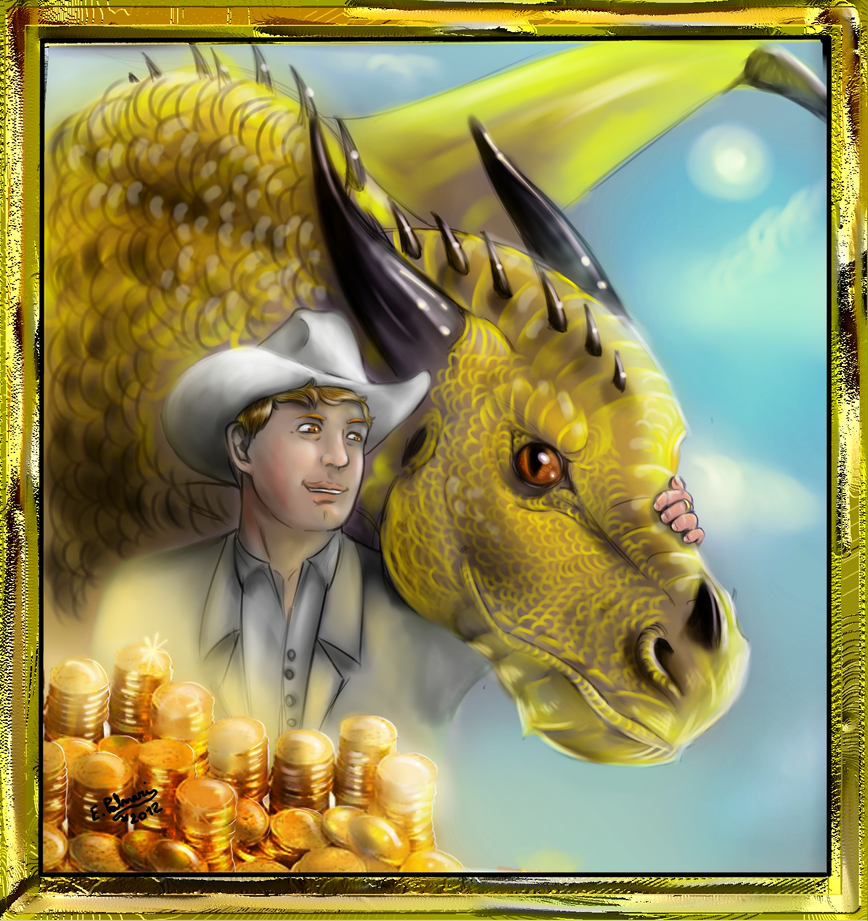
This is an ancient race, which, however, underwent several changes in time to adapt to their mutated lifestyle. At first, major golden dragons were smaller and a tad slimmer, with a skin tone that ranged from light brown to a bright sand color, ideal to blend in savannas and deserts. After starting to coexist with humans, for some reason, golden dragons began to be passionate about collecting precious gems and metals and became guardians of the richest treasures. Their color and physical shape changed: they became thicker, heavier, and took on a color very similar to that of the gold they protected. A major golden dragon, lying on a cascade of gold coins, is almost the same color as the latter; the pattern of their round-edged scales closely resembles a pile of coins, allowing them not to be immediately seen by a thief who comes in to plunder the treasures, thus being able to catch and punish them.

Appearance
The major golden dragons are cousins ​​of the lesser golden dragons, of course, and with them they share the color of scales and wing membrane, both golden. Their similarities end here: the major golden dragon is heavy, with stubby legs and a thick muzzle, capable of collecting the water they drank in body tissues to slowly consume it later, an evolutionary legacy of when these creatures lived in deserts. The horns of the major goldens, as well as all the spines and claws, are smooth and black or very dark brown in color. They only have two pointed, straight horns that continue the profile line of the head backwards. The tip of the tail doesn't end in any barb or keratin tip, as it occurs in other species, but is simply covered with small, almost completely round scales, like pennies.
The teeth are partially differentiated: although they aren't divided into true incisors, canines, molars and premolars, they tend to "imitate" them and are suitable for chewing.
Major golden dragons are medium to large sized dragons, and an adult can weigh up to five tons in weight. Their bones are also hollow, and the wingspan can exceed twenty-seven meters (around eighty-five feet) due to the fact that a huge wing area is required to keep one of these burly dragons in flight!
Despite their mighty wings, the major golden dragons don't like to detach themselves from the ground, and it's considerably tiring for them, but if necessary (especially if it's to save some stolen treasure) they're capable of remarkable aerial sprints.
The ears have no auricle and the eardrum is only protected by a modified translucent scale, called the auroscale, which prevents dirt from entering the eardrum and the eardrum itself from vibrating too strongly during flight.
Often these dragons seem "fat": sometimes this is due to the accumulation of water in the tissues, other times it's authentic fat, as they are very inclined to gain weight and lead a sedentary life.
The sexual dimorphism is remarkable: the males are smaller (although not slimmer), with sharper, longer horns and brighter colors, especially on the wings, while the females have more blunt, shorter horns, more powerful muscles of chest and forelegs, and slightly shorter tail. Males sometimes possess a pair of black spines on the hocks of the hind legs, the use of which isn't clear even to them.

Behavior

Major golden dragons love gold and food, although they aren't as possessive as they may seem: it's not the ownership, but the presence of gold itself that exalts them. Like many other ancient dragons, they have a complex society and hierarchical relationships that are sometimes incomprehensible to humans; for example, respect isn't owed to the head of the flock (although a golden dragon flock is an exceptionally rare event) as much as it is to youngsters with a nice voice, and their greetings vary from rank to rank, and from region to region.

Major golden dragons have a very long memory and remember with precision the faces of other dragons, and also other humans, that they have seen even dozens of years before, hence the treasure hunters must be very careful not to reveal their faces, not even for a second, if the guardian of such a treasure is one of these creatures.
Major golden dragons love to sing as well, and they do so with a low voice, often using totally invented terms, which may seem draconic or some other, more arcane, language to an inexperienced ear. Sometimes they use words from different languages that sound pleasant to them to create song-collages, and are able to imitate even some animal sounds. One of the refrains of the most famous musical lyrics from their culture, reads as follows:

Banana gold animalis
Ek is 'n goeie draak
ang usa ka maayo nga dragon
I am bello drago oh oh oh
*bear sounds* Christmas”

In general, the personality of a major greater dragon is straightforward, direct, open to fun and experimentation, but not too fond of physical activity. They laugh often, with a characteristic sound that resembles a small thunder rumble; they can emit very high-pitched whistles for various reasons, including calling their partner who has strayed too far.

Birth and growth
Major golden dragon hatchlings are born from eggs, incubated for a variable period between two weeks and two months. The eggshell is moderately soft, and touching it is similar to touching a cheese ball; the eggs themselves are able to bounce a bit to avoid getting damaged by small hits.
The baby dragon comes out of the egg thanks to a special keratin tooth, which falls off little after birth, and lacerates the egg shell with the claws. The mother, afterwards, eats the empty shell to take supplementary calcium, and also because of its delicious taste.
The newborn has a yolk sac and don't need to consume food for two or three more weeks after birth, even if the parents often start feeding them immediately. Like all big dragons, they're slow to grow and reach full maturity and the ability to reproduce only after getting over twenty-five years. The growth of a major golden dragon continues at the same rate for the first sixteen years of age, then it slows down without stopping until they reach their maximum weight: five tons.

Social life and courtship
Golden dragons have, as anticipated, an intense social life. They love talking to humans, other dragons, dragons of their kind, and even to themselves.
They don't live in real herds or packs, but they can gather in groups of up to four individuals, colloquially known as "roommates" or "students", because the reason behind these meetings is generally the study of something (which very often happens to be music).
Sometimes, to attract females, males pretend that their older roommates are other females and show themselves as happy couples who then separate after violent quarrels: from that moment on the young male, who has proven to be an excellent partner, is single and ready to be conquered. However, this trick can only work among very young dragons, since as they age, no male could be mistaken for a female.
Other times, males gather in groups and engage in mock fights in order to show their prowess, but this trick generally doesn't work, as females are not interested in males that get involved in scuffles.
Golden dragons don't call courtship by this name, nor do they speak of a mating season: the love season gets the name of "time of tricks", because all the males (since the males are the only ones courting) get busy inventing the funnier skits to impress females with their wit and, sometimes, physical prowess.
Golden dragons don't form stable couples, but estabilish relationships with numerous "friends": dragons to which they are attracted to and that can, during the breeding season, be chosen as partners, while during the rest of the year they meet mostly to sing, talk or hunt together. In the past, it was believed that males had real harems, but actually both sexes can choose between different partners. A male and a female who don't intend to reproduce by choosing the other, but who still live together, are called a "single pair", while a male and a female who live in the same cave and intend to reproduce are called a "double pair", because the average number of eggs laid by a major golden dragon is two.
The hatchlings get cared for by all the roommates, parents, and "friends" of the parents, as in some sort of huge extended family, reason for which they often travel from one den to the other to meet cousins, uncles, half-siblings. The education received by the hatchlings is shorter than in many other species, and, at only three years of age, the little ones are free to stay with their closest relatives or reunite with their favorite siblings and cousins to form a new group of roommates that will go live far away from the original family.
It will very seldom happen that a golden dragon mates with a dragon of another species, especially during their fertile period (which goes from the beginning to the end of March), being particularly proud of their own race and genome and refusing others to interfere with their reproduction. Contrary to what most other dragons do, coupling without a strictly reproductive end is contemplated for goldens; and so sometimes they court outside of the time of tricks other dragon races, which, however, usually aren't as inclined to spend energies on a mating without gaining eggs from it.
A popular saying goes that all major golden dragons know each other, like friars in a convent, and it really seems to be true: each golden dragon on the planet has seen, at least once in their life, every other golden dragon existing. How can that be possible, since adults travel little or nothing, is an authentic mystery.

Habitat and diet
Major golden dragons love dry places. Wet caves, full of treasures? Not their cup of tea, despite the treasures that would certainly tickle their interest. Golden dragons love warm stone, sand, and cactus (which are part of their diet), so they're widely spread in the Equatorial zone and in the deserts of Africa and America (where they have arrived long before Christopher Columbus and without knowing how, since they're not fond of traveling). They're omnivores, although with a carnivore tendency, and eat literally any animaly, even the small ones like flies and cockroaches, despite them being of almost no sustenance for them. One of their most common sayings goes: "Every little fly liver is substance", meaning that every food crumb concurs to their feeding; their propension to catch and swallow small moving things can even seem pathological.
In order to hunt bigger preys they bury themselvs under sand dunes, or cover their bodies with twigs, and wait in complete stillness until preys literally put their feet on their head to, very simply, open their jaws, snap their powerful neck and kill their prey, then enjoy eating it with calm.

Famous major golden dragons
Dollaro
Picustia Gro'baker

Trivia

  • The crossing between a major golden dragon and a guardian dragon is called treasurer dragon, and is considered to be one of the most lethal and "perfect" dragon races.
  • The crossing between a major golden dragon and a white dragon is called "angel dragon" and is sterile, so it can't be considered as its own race.
  • The crossing between a black dragon and a major golden dragon is a slightly fatter black dragon.
  • The eggs of major golden dragons get jokingly defined as "cheeses".
  • The words "fat" and "obese" are considered non-existent by major golden dragons, which often also fake not understanding them.
  • Exuvias left behind after molting by golden dragons are golden as well, and of great value.
  • Golden dragons are perfectly able of spitting fire, but many believe them to be unable to do to so because they almost never do it.
  • They spit though. And their saliva is dense and sticky like glue.
  • Julius Ceasar was a dragoneer and had a golden dragon, but she was so lazy that she rarely came out of her den, and so many didn't know of her existence. Her name was Pallal.
  • Originally, major golden dragons had six fingers for each paw: the number was reduced in time to five for each of the front paws and four for each of the hind paws.
  • In 1100 the draughts game was invented, but few know that it was a major golden dragoness, Picustia, to invent it with the rules that we know today!
  • In France they were known as Dragons des pierres, aka stone dragons, referring to the precious stones.
  • In the Zulu language they're named sawubona isibankwa, freely translated as “greeting lizards” due to their tendency to greet passersby.
  • In English they were known, other than as “Major golden dragons”, also as “gay dragons” because of their happy, joyous attitude that allowed them to face with a light heart even the grief caused by loss of a family member. This definition was lost, sadly, to be replaced by a gloomy “fat yellow dragons”.
  • When a major golden dragon dies, their family will give a name similar to the one of the deceased to a newborn hatchling. For example, if the dragon that has passed away was called “Oester”, the family could give to the new baby the name of “Chester”.
  • They're not as fat as their nicknames and hunting technique could suggest, but just a little lazy: they're totally able to run for a long time (even if not at great speed) and to perform exceptional flying sprints (even if not for too long).
  • Their scales were once considered a good of immense worth, and the horns of the dead specimens were being used as raw materials to produce statuettes and other decorative objects.
  • They hate eating lemons, but not lemon leaves.
  • The "trivia" section for the major golden dragons sheet is the longest ever written for any "trivia" section ever written for sheets that describe dragon races.

🌵🎨 All the drawings in this page (and probably in all the other pages, if not differently specified) were realized by our artists, Furiarossa e Mimma. You can see more of their works and support them on their Patreon page. Become patrons of the arts! 🌵🎨

Lettori fissi