Visualizzazione post con etichetta dragon. Mostra tutti i post

mercoledì 14 settembre 2022

Angel dragons

(Hai perso la strada, viandante? Se stai cercando questa pagina in italiano, puoi trovarla QUI!)


Draghi angelo
(Verusdraco sapiens alba x aurea)

Origin
Angel dragons are born from the crossbreeding of a white dragon and a major golden dragon.
Hybridization between these two races happened enough times to ensure that this creature gained a name, evidence in history, and even stereotypes about it; however, since all angel dragons are in fact infertile, they can't be considered their own Verusdraco subspecies.
The term "angel dragon" was attributed to them both referring to the light hues of their bodies, which often show colorations with abundant white and golden, and to their behavior that is commonly thought as protective, good-natured, and endowed of a strong moral sense.
The first time the words "angel dragon" have been used explicitly referring to this kind of Verusdraco was in a text from 1289 (in the Bestiarium Raritatis, "The Bestiary of Rarities", a tome in Latin of which the last copy left is located in the town of Bareblia), although there's some previous, rare descriptions in some draconic tales that could, indeed, be about angel dragons, proving their existence from since before they received a name.

Appearance
Angel dragons are medium to big-medium sized dragons; they can include in their colorations white, light blue, peach pink, and golden.
Their appearance rarely gives an impression of homogeneity: angel dragons often show different colored areas that contrast with each other, some more opaque and some more metallic, a build that's more massive in certain points and thinner in others (in particular, they often inherit a slim tail from white dragons). Despite the fact that this often doesn't gift them with an especially elegant or mimetic look, they're actually considered to be beautiful creatures due to the complexity of their appearance. Build, size, and looks are fairly variable from an individual to the other, dictated by the genetic cocktail inherited by their parents, although they often happen to get the slow metabolism of golden dragons and their tendency to accumulate fat and water in body tissues.
Their scales, flexible and hardy, have round edges; the skin underneath is light brown or liver colored, sometimes mottled with lighter hues like sand or pink.
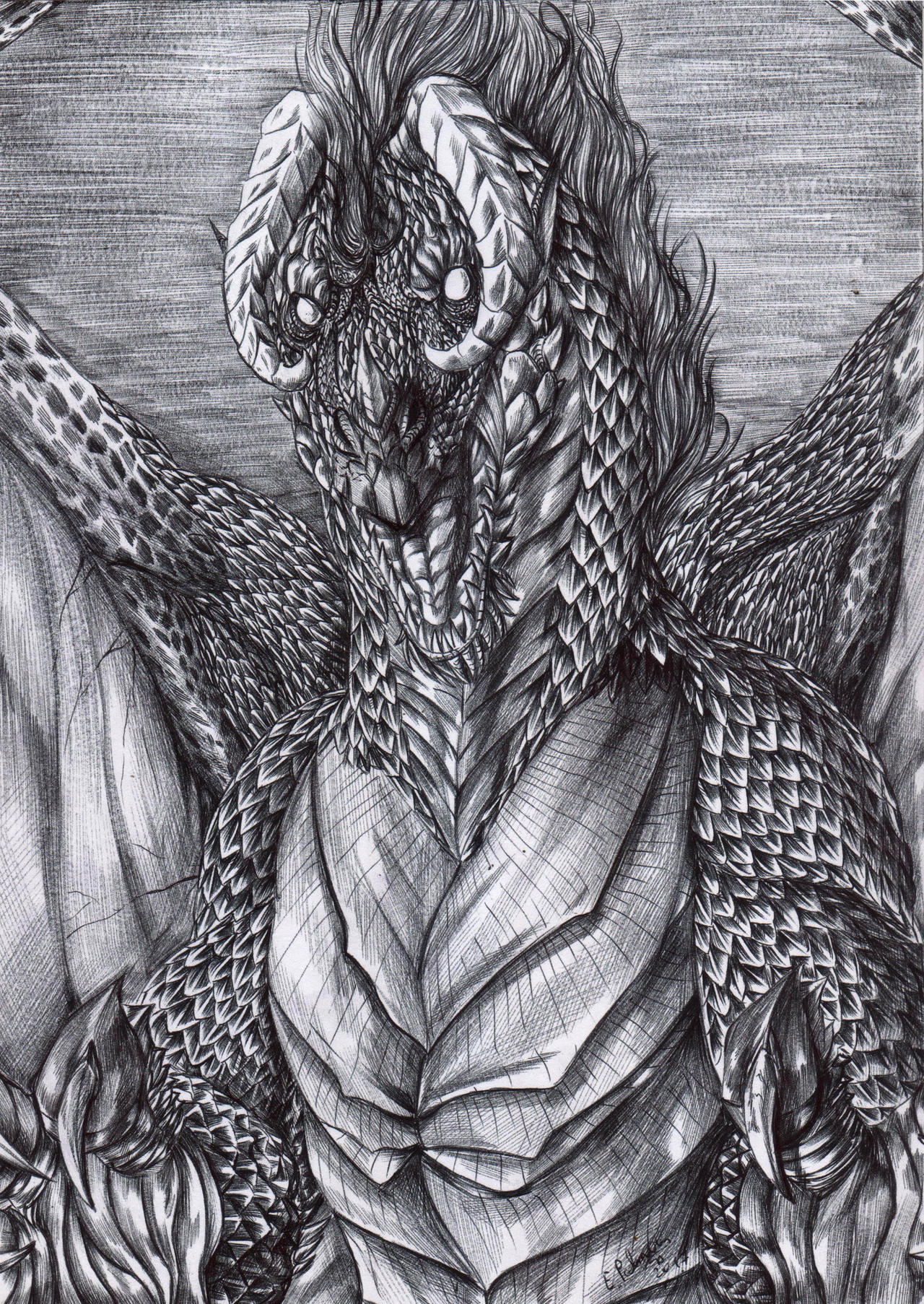
Their back is covered by a row of sharp keratin thorns, and, sometimes, a variable number of spines adorn their cheeks, hocks, and base of the neck. The black horns on their head are straight and pointy, extending behind their skull following the line of the forehead.
Angel dragons can have a little horn growing between their nostrils, more or less developed: sometimes it's just a dark plaque. Claws, horns, and thorns are generally black or dark brown, with rare exception of golden, and they're smooth and sharp.
The eyes of angel dragons, described in the Bestiary of Rarities as "clever, cunning even, but benevolent", are always light blue or golden.
Their wings have hollow bones and are pretty big as a rule, which allow these dragons to perform remarkable aereal sprints, with one or two keratin hooks on the top.
Considering the specimens' variability it's pretty difficult to identify a sexual dimorphism, if not for the fact that females tend to reach greater size and weights compared to their male counterparts; the record for maximum height ever scored belonged indeed to a female, named Roclippì, which measured exactly seven meters (twenty-three feet); she had an impressive wingspan of twenty-eight meters (almost ninety-two feet), for a weight of a little over five tons.
Their ears lack auricles, and the eardrum is protected by the auroscale: a modified, translucent scale that prevents the eardrum from vibrating too much during flight and from getting dirty.
Angel dragons often have partially differentiated teeth, like major golden dragons, but the mix with the genetics of white dragons seems to bring a special emphasis on their canines, which are particularly showy in some specimens.
Angel dragons' fire is often pink or pale yellow; some of them are also able to produce a dense saliva, sticky as glue.

Behavior
Angel dragons are distinctly social creatures, able to quickly interiorize quirks and mannerisms of species other than their own and to fluently use this new "language" when interacting with them. They love company, and their iron memory allows them to easily remember names and informations, which also gives them an advantage when learning new idioms.
When they're raised with care and love, it's natural for them to estabilish an empathic contact with animals, dragons of other species, and human beings; this is also why almost every angel dragon ever witnessed has bonded with at least a human, accepting them as their dragoneer.
They're usually sunny and balanced dragons, intelligent, compassionate, but they have a big weakness: the vulnerability to gold greed.
Angel dragons love to collect books and precious stones, which compose their personal hidden treasures and of which they're very jealous, but gold has a special impact on them: its only presence makes them exalted, greedy, reason for which a good portion of angel dragons try to avoid entering in contact with this substance.
In the most severe cases, if an angel dragon has managed to hoard a gold treasure and hits a moment of particular psychological fragility, the situation can degenerate in a real psychosis, in which the individual will start isolating from everyone else and living in their treasure chambers, believing they have to defend their fortune from everything and everyone, or it will be stolen from them.
Despite being considered good, wise dragons, it's also due to this impulsive side of them that they never manage to occupy high political offices among dragons, since those require to show strong self-control and discipline.
 
Birth and growth             
Angel dragon hatchlings are born from eggs, that have to be incubated for a variable period that goes from two weeks to two months.
If they're lacking the adequate heating, these eggs can remain quiescent even for hundreds of years before hatching.
The eggs from which the little angel dragons will be born usually look like a common egg of the mother's species (if the mom is a golden dragon, it will look like a "cheeseball", a golden dragon egg, while if the mom is a white dragon the egg will look just like a regular one of her species), but if the mother is a white dragon the difference becomes apparent from the fact that the baby doesn't need the presence of the human they will bond with to hatch.
Newborn angel dragons have a special keratin tooth, which falls shortly after birth, that they use to help themselves opening the shell of their egg from inside. Newborn hatchlings weigh between 500 and 900 grams, and they're already curious and active, ready to explore the world.
Angel dragons grow moderately slow, reaching full maturity and the ability to reproduce around sixteen years of age. At this point, some angel dragons considerably slow down almost to an halt, while others only reduce their growth rhythm and continue growing until they reach their max weight, around five tons.
From that moment on they'll keep on growing anyway, but so slowly that it's impossible to perceive unless it's from one millennium to another.
Like all dragons they're extremely long-lived, so much so that no angel dragon has ever died of old age.

Social life and courtship
It's extremely rare for an angel dragon to be able to interact with another angel dragon, especially in their first years of life, so their first teachings about morality, religion, and hyerarchy will be imparted from the family in which they'll grow up... be it an adoptive species, the eccentric, noisy familial culture of golden dragons, or the accademic, moral education of white dragons.
All angel dragons are sterile; some don't even feel the impulse to reproduce and don't let themselves be involeved in courtships, while others mate for recreational purposes, especially if raised in golden dragon communities, but once they discover their own infertility they usually engage in such activities only outside of the reproductive season.
 
Habitat and diet
Angel dragons easily adapt to both cold and warm weather, and they seem to have a fondness for islands and coasts, estabilishing their lairs inside grottos and marble caves that aren't too far from the sea, despite the fact that nor white dragons nor major goldens usually live in similar habitats.
Angel dragons love food, and they're prevalently carnivorous omnivores. They mainly feed on fish and meat, but they don't disdain almost any kind of aliment; they enjoy fat foods like avocadoes, nuts, and oil seeds, but they mainly consume them as babies, due to the exiguous size of these aliments compared to their adult tonnage.
They tend not to kill any creature that they deem particularly intelligent, like octopi, humans, and dolphins, on which they can feed in case they find freshly dead bodies. If they were raised by white dragons, though, they inherit from them the taboo that prevents them from eating humans in any case.

Famous angel dragons
  • Roclippì
  • Atrebor


Trivia and facts

  • The last known angel dragon egg, survived to the extermination caused by the Pater Inferorum, was initially identified as a major golden dragon egg, revealing the truth only several centuries later when it hatched.
  • The last and only angel dragon of the current century is named Atrebor, and at the moment she's living in the marble caves of Patagonia.
  • Many angel dragons have a certain affinity for music and singing, a talent that helps them climb hyerarchies among major golden dragons.
  • Some attribute a mystical aura to angel dragons, due to their looks and rarity, so, even if they're often excluded from prestigious political offices, if they wish for it they easily obtain religious ones.

 
Image gallery (Click to enlarge!)

++
+
+
+
+
+
+
+
+
+
+
+++


🌵🎨 All the drawings in this page (and probably in all the other pages, if not differently specified) were realized by our artists, Furiarossa e Mimma. You can see more of their works and support them on their Patreon page. Become patrons of the arts! 🌵🎨

sabato 24 aprile 2021

Character - Orotagon

(Ti sei perso, viaggiatore? Se stai cercando questa pagina in italiano, puoi trovarla QUI!)


Orotagon Arevates Aretosson


Species: White dragon (Verusdraco Sapiens alba)
Full name: Orotagon Arevates Aretosson
Gender: male  
Height: 4 m
Weight: 3050 kg 
Body type: Average dragon 
Zodiac sign: Aries
Occupation: Chief of the Ancient Dragonery guild / vice king 
Smells like: Steel, fire, clean sheets
Nationality: Hornian

Appears in: Io sono il Drago (book) |


Likes
Dislikes
❤ Justice
❤ White lilies
❤ Marble
❤ Humans
❤ Reading
❤ Studying magic
❤ Glorious architecture
❤ People who makes an effort
💔 Injustice
💔 The letter F
💔 Drugs and people who use them
💔 Violent dragons
💔 Savage people
💔 Anarchy
💔 Honeysuckle (color)
💔Chimerae


Skills
[Possible levels: disaster | beginner | mediocre | good | very good | excellent | master] 
Physical
- Acute eyesight (very good)
- Acute smell (excellent)
- Flight (good/very good)
- Dosing his immense strength (very good/excellent)
- Running (good)
- Scales impervious to magic (very good/excellent)
- Powerful roar (very good/excellent)
- Fire spitting (very good)
- Weight lifting (very good)
- Healing factor (good)  
  
    
Language 
- Hornian (very good written and spoken, excellent in comprehension)
- Green Elvish (good in written and spoken, mediocre in comprehension)
- Black dwarf (mediocre in written and spoken, good in comprehension)
Musical
- Singing (very good)
 
Magical- Mind reading (very good)
- Casting spells - generic - (very good/excellent)
- Magical fire (excellent)
- Breaking sygils (very good/excellent)
- Magical shields (very good/excellent)
- Mental bond with his dragoneer (excellent)
- Hypnosis (very good)
     
Miscellanea 
 
- Killing in cold blood (disaster/beginner)
- Writing books (very good)
- Distinguishing counterfeit banknotes (excellent/master)
- Keeping secrets (beginner)
- Taking decisions (very good)
- Being diplomatic (excellent)
- Resisting to the "gold call" (excellent)
- Memory (very good/excellent)
- Flirting (disaster/beginner)


Image gallery (Click to enlarge the pictures!)
 

+
+
+++
+++
+++


All the drawings in this page (and probably in all the other pages, if not differently specified) were realized by our artists, Furiarossa e Mimma. You can see more of their works and support them on their Patreon page. Become patrons of the arts!

martedì 3 gennaio 2017

Draghi Oscuri

Draghi Oscuri

(Verusdraco sapiens atra)

Origine
Si tratta di una razza di draghi nata in Germania e relativamente giovane, formatasi con chiari caratteri nel 1331, a seguito di una mutazione spontanea del drago nero (Verusdraco sapiens nigrum) che ha dato vita ad un cucciolo che possedeva innumerevoli caratteri recessivi contemporaneamente. Il primo esemplare di drago oscuro mai nato si chiamava (e si chiama, essendo tutt'ora vivo) Ermes Siegader To'Rvak ed è disgraziamente conosciuto per essere l'autore del Grande Scisma, la separazione delle razze senzienti su questo pianeta e il disconoscimento dell'esistenza dei draghi da parte degli umani. Nonostante queste origini incresciose, non bisogna farsi trarre in inganno dal nome stesso di questa razza: l'unica cosa scura, nel loro intero essere, sono le squame, mentre il carattere è di solito gentile e amorevole.

Aspetto

I draghi oscuri, come il nome rivela, hanno squame nere che possono avere diverse sfumature, dal colore della pece al grigio molto scuro e suddette squame sono conosciute per essere spesse e coriacee, sebbene non tutti gli esemplari possano godere di un'armatura naturale capace di fermare i proiettili. Le corna, rivolte all'indietro nel loro vicino antenato drago nero, sono rigirate in avanti nel drago oscuro e sono costituite da un'impalcatura ossea ricoperta di sostanza cornea di colore dorato-caramello, spesso macchiettate di bruno o di grigio, con nodi vistosi e affilati che danno al corno un aspetto frastagliato. Anche le punte dorsali e gli artigli sono dorati e questi ultimi sono parzialmente retrattili, stretti e più lunghi di quelli dei draghi neri. Situati a sormontare le narici, si possono trovare da uno a due corni conici.
Una delle caratteristiche che permette di distinguere a colpo d'occhio un drago oscuro è la sua criniera, fatta di peli spessi e simile a quella di un cavallo, che protegge la parte centrale e superiore del collo, dove le squame sono naturalmente più rade, e che può avere diverse lunghezze a seconda dell'esemplare.
Le orecchie possiedono un padiglione esterno mobile, appuntito e relativamente piccolo.
Sono draghi di taglia grande e un adulto può pesare fino a cinque tonnellate e mezza di peso, una taglia considerevole se pensate che hanno ossa cave e sacche di aria nel petto, essendo perfettamente atti al volo. L'altezza massima mai registrata da un drago oscuro è di dieci metri e sessantacinque centimetri, con un'apertura alare di oltre venticinque metri! Tuttavia, giunti a queste dimensioni, i draghi oscuri iniziano ad appesantirsi e pur potendo ancora volare, preferiscono rimanere a terra per non sprecare enormi quantità di energia.
La loro coda è potente e mediamente lunga, con la parte finale che si assottiglia e culmina con una punta cornea, anch'essa dorata, estremamente resistente. Un drago particolarmente abile può fare schioccare le coda come se si trattasse di una frusta.

Comportamento
Non ci sono molti dati riguardo al comportamento dei draghi oscuri e Ermes sembra distaccarsi dalla norma della sua specie, mostrante in genere un carattere temperato e solido, gentile, non incline alle nevrosi o alle manipolazioni. Nonostante siano draghi potenti e capaci di utilizzare la magia, non sono soggetti ai tipici complessi di superiorità dei draghi medio-grandi.
Non vivono in branchi anche perché un branco di draghi oscuri divorerebbe tutto il cibo presente nel territorio e sarebbe costretto a spostarsi immediatamente, mentre essi sono stanziali e preferiscono condividere con altre specie molto più piccole i loro rifugi.

Nascita e crescita

Come la maggior parte dei draghi, i cuccioli di oscuro nascono da uova, incubate per un periodo variabile da sette mesi a tre anni. In mancanza di fonti di calore, il cucciolo rimane in stato quiescente finché non viene nuovamente riscaldato e riprende il suo sviluppo; le uova di drago oscuro sono perciò molto semplici da trasportare e da conservare: tutto ciò che necessitano è un luogo freddo, con una temperatura preferibilmente sotto i dieci gradi centigradi. Il guscio dell'uovo è ricoperto di cheratina ed è abbastanza resistente, ma può essere rotto con un pugno ben assestato. Il draghetto non è in grado di rompere da solo il guscio: i genitori devono aiutarlo ad uscire o rischia di morire per anossia.
Alla nascita, un cucciolo di oscuro pesa da 900 grammi a 1,50 kg ed è lungo circa settanta centimetri compresa la coda, ha ali già formate, ma è incapace di volare a causa della debolezza dei muscoli dorsali, che vanno allenati. Le punte dorsali sono appena accennate e le corna corte e tozze, ancora lisce per l'assenza di nodi, mentre gli artigli sono già completamente formati e funzionali.
Il piccolo è fin da subito capace di cacciare e cattura insetti, lucertole e topolini che consuma in grandi quantità, spesso aiutato dalla madre e dal padre che condividono con i piccoli bocconi delle loro prede.
I draghi oscuri sono lentissimi a crescere e raggiungono la piena maturità e la capacità di riprodursi solo superati i vent'anni. Un caso a parte sono i non rari esemplari ermafroditi, come Ermes stesso, la cui maturazione avviene ancora più lentamente rendendoli incapaci di produrre prole fino ai settant'anni di età. La crescita fisica di un drago oscuro continua allo stesso ritmo per i primi cento anni di età, dopodiché rallenta drasticamente senza fermarsi però del tutto.

Vita sociale e corteggiamento
I draghi oscuri, come già accennato, non vivono in branchi, ma ciò non significa che non siano sociali: essi infatti fanno spesso visita ai loro conspecifici che vivono in territori limitrofi e accettano persino nel proprio nido animali di specie diversa, come umani, cani o altri piccoli draghi, di cui si prendono cura.
Talvolta vivono in coppia, sebbene le coppie non siano forzatamente stabili per tutta la vita.
Non esistendo maschi all'interno della razza, ma solo ermafroditi e femmine, il corteggiamento è diverso rispetto a quello di molte altre varietà di draghi: non ci sono infatti ruoli ben predefiniti per un sesso o l'altro ed entrambi i partner si espongono mostrando i propri talenti. Talvolta, i draghi oscuri femmina possono scegliere come partner un drago nero o un altro esemplare del genere Verusdraco, dando origine ad una prole che somiglierà comunque a lei, seppure con caratteristiche minori ereditate dal padre.
Gli esemplari ermafroditi depongono un numero di uova generalmente inferiore a quello delle femmine, essendo queste ultime più grandi e pesanti.
Non esistono periodi specifici in cui i draghi oscuri si riproducono, ma quando una femmina ha dentro di sé uova mature, le ghiandole presenti nella sua gorgiera emettono un odore che richiama i maschi di altre specie e gli ermafroditi di drago oscuro per dichiarare che è pronta ad accoppiarsi. La formazione delle uova dipende da fattori ambientali: quando il cibo è abbondante e nei territori vicini non ci sono altri draghi di taglia grande, la femmina può decidere di dare il via all'inizio della formazione delle uova, che verranno in seguito fecondate da uno o più padri, sebbene sia estremamente raro che una cucciolata appartenga a padri diversi. Le uova sono deposte a circa quarantott'ore di distanza dall'accoppiamento e sono di colore ambrato, ma la superficie si ossida a contatto con l'aria e diviene di un colore che va dal bruno scuro al nero.
Il nido viene costruito da entrambi i genitori ed è generalmente costituito da un'impalcatura di rami e rocce, ricoperta di paglia, erba e pelli e piume di animali che trattengano il calore anche quando uno dei genitori deve assentarsi momentaneamente dalla cova. Sia il padre che la madre riscaldano le uova, dandosi il cambio e usando talvolta il loro respiro infuocato per appiccare letteralmente il fuoco al nido, le cui parti combustibili vengono consumate e successivamente ricambiate, mentre il cerchio di pietre esterno serve da frangifuoco e per il mantenimento del calore.

Habitat e dieta
I draghi oscuri sono distribuiti in quasi tutta Europa e prediligono i boschi folti e in generali i luoghi bui e selvaggi, molto lontani dalle città, in cui possano deporre le loro uova e crescere i loro cuccioli indisturbati. Il territorio di un drago oscuro, o di una coppia, è vasto dagli ottantacinque ai trecento chilometri quadrati.
La loro dieta non è composta di sola carne, come avviene con i più piccoli draghi predatori, ma è ampiamente integrata di frutta, radici e semi. Da giovani hanno bisogno di un maggior apporto di proteine, mentre la sua dieta diventa più bilanciata con l'età: un neonato mangerà il 100% di carne, un giovane esemplare si nutrirà di circa il 40% di vegetali e il 60% di animali, un adulto si ciberà prevalentemente (fin quasi al 75%) di vegetali, con un'importante predilezione per la frutta.
I loro cibi preferiti sono le vespe, gli agrumi in generale e la frutta fermentata. L'alcool su di loro non ha alcun effetto negativo ed essi possono berne in grande quantità e metabolizzarlo tranquillamente come farebbero con l'acqua.
Il loro sistema immunitario è forte, ma non come quello di altri draghi, e non possono mangiare carcasse troppo vecchie.

Draghi oscuri famosi
Ermes Siegader To'rvak
Shadow Ermesson

Curiosità
  • Il primo drago oscuro mai nato era un ermafrodita autosufficiente, cioè capace di deporre uova fertili senza accoppiarsi!
  • Mangiare molto cervello può modificare temporaneamente il loro comportamento, rendendoli meno inibiti come farebbe l'alcool con gli esseri umani.
  • Sono l'unica specie attivamente magica di drago che supera i dieci metri di altezza.
  • Possono avere solo gli occhi verdi, ma possiedono un paio di palpebre protettive (come quelle dei coccodrilli) che può rimanere chiusa e dare all'occhio un aspetto lattiginoso e biancastro.
  • Tutti i draghi oscuri mai nati hanno avuto nomi che gli sono stati assegnati dagli esseri umani e mai da un altro drago.
  • La grandezza delle femmine di drago oscuro è proverbiale. “Spostati, che mi sembri una dragonessa oscura” è un modo di dire piuttosto comune fra i draghi, per esprimere la grossezza di qualcuno che gli ostruisce completamente la visuale.
  • La criniera di un drago oscuro viene definita “capelli”.
 
Galleria d'immagini (Clicca per ingrandire!)


Cucciolo
Cucciolo in gabbia
Con un drago dorato
Giovane affronta gufo mostro
Con dragoniere (Mark McWoodland)
Cuccioli ibridi con drago dorato
By edge-chan


🌵🎨Tutti i disegni in questa pagina (e molto probabilmente anche in tutte le altre pagine, se non diversamente specificato) sono stati realizzati dalle nostre artiste, Furiarossa e Mimma. Potete vedere altri loro lavori e/o supportarle (e supportare così anche tutti i Cactus di Fuoco ;)) sulla loro pagina Patreon. Diventate patroni delle arti!🌵🎨


domenica 23 novembre 2014

Personaggi: Ermes Siegader To'rvak


ERMES SIEGADER TO'RVAK


Specie: Drago oscuro (Verusdraco sapiens atra)
Nome completo: Ermes Siegader To'Rvak
Genere: Ermafrodita completo (utilizza pronomi maschili)
Altezza/peso: 3,83 m (alla testa) / ???
Struttura fisica: Magra, ma forte
Età alla prima comparsa: Neonato
Data di nascita: 3 Marzo 1331
Occupazione: Consigliere dell'Antica Dragoneria / Commerciante di simulacri / Signore della guerra / scrittore / inventore
Odora di: Argento, polvere e fuoco
Provenienza: Schwarzwald (Foresta Nera)
Nazionalità: Horniano
Appare in: Io sono il Drago (libro) | Scontramondi 1. La Pietra delle fonti (libro) |


Curiosità:

  • Ermes nacque esattamente cent'anni prima di Vlad Dracula, che idealmente sarebbe il suo dragoniere perfetto.
  • L'artiglio perso da Ermes verrà lavorato per divenire la spada di Nadia, dragoniere del drago bianco Aureo, un simbolo di luce e di speranza
  • Il simbolo di Ermes, usato nei documenti e sugli stendardi, era un dragone nero impennato, racchiuso in un cerchio, con alla base il numero 666
  • I settari dell'”Ermes Om'Ta”, o moderni ermeti, seppure si dicharino servitori del potente Maligno, sono stati dichiarati dal drago stesso come “non-ufficiali” e “abusivi”


Galleria di immagini (Clicca per ingrandire!)


Ermes e Smaug
Ermes e Shadow

Simulacro

 
Ermes cucciolo in gabbia


Dollaro ed Ermes


Ermes e il gufo di Gunkanjima

Ermes adolescente
Ermes giovane e Paulus


Ermes Cucciolo


Ermes neonato


Pixel art: sequenza di crescita
Ermes e Vlad

Vlad e Ermes

(Art by Novatonix)
(Art by Kshanti)
(Art by Edge-Chan)

(Art by Ficthiilicious)

by OliverTrash
By Crowfangs
by Frizzoshark
By nocnadusza
By Furredbeast

Con Shadow
+++
+++
+++
+++


Tutti i disegni in questa pagina (e molto probabilmente anche in tutte le altre pagine, se non diversamente specificato) sono stati realizzati dalle nostre artiste, Furiarossa e Mimma. Potete vedere altri loro lavori e/o supportarle (e supportare così anche tutti i Cactus di Fuoco ;)) sulla loro pagina Patreon. Diventate patroni delle arti!

Lettori fissi