Visualizzazione post con etichetta creatures. Mostra tutti i post

venerdì 13 marzo 2026

Deep-sea merfolk

(Ti sei perso, viaggiatore? Se stai cercando questa pagina in italiano, puoi trovarla QUI!)  

Deep-sea merfolk (Abyssugens hispida), sometimes written as deepsea merfolk or deepsea siren, are sentient creatures that inhabit the abyssal zone, unable to survive naturally at low pressures, especially long periods out of the water.

Despite their misleading name, deep-sea mermaids are not part of the merfolk family, although deep-sea mermaids were once mistakenly classified as Maregens hispida.

Abyssugens are mysterious creatures, statistically almost never coming into contact with surface creatures. They are highly intelligent, but any rare interaction with other sentient creatures has invariably labeled them "weird": speaking a completely different language and living a solitary lifestyle in the deep, where concepts and priorities are markedly different from those of the surface waters or even on land, can make communication with a creature unlike themselves difficult.

Abyssal sirens have been reported to be capable of creating exquisitely effective magical artifacts; they are resourceful alchemists and artisans, inventing any trick to make their lives easier. They are true opportunists, seeking maximum yield from minimum effort, a trait necessary for them to survive in the harsh environment of the abyssal depths.
They are also called abyssal merfolk, people of the abyss, or simply abyssals.

Conservation status

Data Deficient (DD): The available information is insufficient to provide a direct or indirect assessment of the risk of extinction.

Appearance and Physiology

Deep-sea merfolk have decidedly less human-like features than their surface counterparts, the Maregens. Their heads are more flattened, with a blunt but more prominent snout, slightly upward-pointing, revealing a pair of mouths, both functional and equipped with thin, sharp teeth, designed to tear flesh and hold prey during their lightning-fast attacks. Their nostrils are slanted and sensitive.

It has been reported that, although both are perfectly functional for both sound and feeding, many deep-sea sirens prefer to eat from one mouth and sing from the other. Over time, the singing mouth's tongue thickens and becomes more trained, making it visible to the eye which is which; both tongues are mobile and pointed, smooth, and pink.

Their skin is thick and tough, covered with tiny, adapted scales whose structure and shape are vaguely similar to those of the placoid scales of sharks and rays, which leave room for photophores. As pups, they lack these, so their internal organs and veins can be seen through their delicate skin.

Deep-sea merfolk have an elongated, almost tapered silhouette, with a distinctive posture that sees them hunched forward. They tend to remain static, upright when at rest; they have a prominent, jagged-looking dorsal fin, an anal fin, and a large, modified caudal fin, which has split to be flanked by two smaller fins (more abundant in photophores; it is uncertain whether these are decorative or somehow enhance their swimming ability). On the upper body, they have two double-jointed limbs (at the elbow and wrist), called arms, capable of rapid, wide movements, culminating in bony, webbed, prehensile hands with opposable thumbs. They also have backward-pointing bony tips at the elbow.

Their large, round eyes are lidless, revealing the large white ring of the sclera. They are surrounded by photophores on the skin that emit a pale blue or aquamarine light on command, allowing them to pierce the darkness of the abyss and gaze around comfortably. Due to the arrangement of the photophores, it might seem as if their eyes themselves are glowing, but this is not the case. Unlike fish, they are not fixed, and a deep-sea mermaid can rotate them in their sockets to direct her gaze at will; at rest, they exhibit a certain lack of focus.

In addition to their eye contours, deep-sea merfolk have a high concentration of photophores on their tails, which can create impressive light displays. These patterns are generally slightly different from one individual to another, and they do so from birth, which is why a single flash is enough for a deep-sea mermaid to recognize a previously encountered individual. Deep-sea merfolk' bioluminescence is possible thanks to specialized mitochondrial cells within their bodies called "photocytes," which create light internally by oxidizing a protein called luciferin, bringing it into contact with the enzyme luciferase. These photocytes are found inside the photophores, organs contained in the skin of deep-sea merfolk and several other deep-sea organisms. They have a glandular portion, from which the light emanates, a reflective layer lining the bottom, and refractive devices, a sort of organic lens that condenses the light.

Given the low temperatures, the most delicate parts of deep-sea merfolk's bodies are protected by thick gray or white fur, which grows around the head and throat, leaving the gills exposed. These are protected by both a gill cover and tufts that grow on the jaw and cover the respiratory openings when viewed from the front.

The bones of deep-sea merfolk are light and relatively flexible, yet fragile due to the difficulty in obtaining calcium at the depths where they live.

Their stomachs are more elastic than those of many other animals, allowing them to eat and store as much as possible if they manage to find a large amount of food at once.

Average life expectancy

Unknown, even to deep-sea merfolk. Deep-sea merfolk have a hard time keeping track of time, and their perception of the sequence of events is confusing and often almost nonexistent, so much so that their language has no word for "time," nor even for "present," "past," or "future." For them, the world is divided into "what I know" and "what I don't yet know," thanks in part to their incredibly precise memory.

Sexual Dimorphism

There is marked sexual dimorphism in adults, making it easy to distinguish males from females at a glance. The first factor to consider is size: including the tail, the male rarely exceeds 1.4 meters, compared to the impressive 5 meters of the female. This is clearly a phenomenon of deep-sea gigantism: the large size of a deep-sea animal would result in less heat loss, crucial in deep waters that rarely exceed freezing points, and a reduced need for constant activity, a characteristic of small organisms.

Furthermore, males tend to have more delicate colors, generally cool shades of blue, gray, and purple, with dark streaks and patterns running across their bodies. In contrast, females rapidly darken as they grow, reaching pitch black as adults.

Habitat and Diet

Deep-sea merfolk have made the saltwater between the deep bathyal zone and the beginning of the abyssal zone their home, moving up and down depending on the water's turbidity and the time of year, almost always finding themselves immersed in the aphotic zone, the area inaccessible to sunlight. We are therefore talking about a variation between 1,800 and 2,000 meters deep.

Their diet is exclusively carnivorous, which has forced them to become very unfussy and excellent predators. They would not disdain feeding on human flesh or that of other mermaids, sometimes even resorting to cannibalism.


Behavior

Sociability


Deep-sea mermaids mostly lead solitary lives, except for the time mothers and their young spend together during the young's early development.
A deep sea merfolk baby with active photophores.

The mother remains with her young for the first five years of their lives, providing protection, food, and teaching. The fries group together in small platoons (a term that in Maregens and Abyssugens indicates medium-sized groups of four to thirty individuals). The mother's attitude, while loving, is far from purely altruistic: to avoid getting lost in the darkness of the deep sea, the young deep-sea merfolk make extensive use of bioluminescence and sing small, high-pitched, melodious calls to signal their presence to their family. However, by doing so, they also attract various predators, which the mother, using her young as bait, can catch and devour much more easily. The song of the young deep-sea sharks has been compared to that of a songbird: high-pitched, sometimes modulated, but somehow "eerie" or "nostalgic" to human ears.

By the time they're five years old, deep-sea merfolk have become too large for their mother to benefit from sharing food with them, so she stops feeding them and encourages them to find a different area to live in. At that point, the young disperse and will likely live isolated lives that may or may not be interrupted by a brief encounter with another of their kind and, perhaps, a fortunate mating.

Even as adults, they retain charming, harmonious voices, a characteristic likely unique for creatures of their habitat. They are significantly less capable of ranging the sounds they emit and replicating the speech of other creatures than merfolk, especially considering that speech has little or no use for them beyond the age of five; the long-distance call they emit to advertise their location and availability to potential mates has been described as a sort of melodious "whine," a mix between the song of a whale and that of a great black-throated loon.

Hunting

Deep-sea merfolk are opportunistic hunters, rarely wasting energy actively chasing and searching for their prey. Much more commonly, they use the stun technique to hunt: they have a very keen sense of smell, and when they sense something approaching, they activate all their photophores in a flash that can stun the intruder. If it's dangerous, they immediately turn off their photophores and flee; if it's potential prey, they lunge to grab and kill it instantly. Their approach is different if the prey is a conspecific (see Courtship and Reproduction).

Several deep-seamerfolk can also use tools and artifacts they create themselves, based on lessons taught by their mother and on long-term experimentation. They are voracious predators that will readily devour any animal smaller than themselves that is safe to eat; This could make female deep-sea mermaids decidedly dangerous to humans, were it not for the fact that the two habitats are so distant that the danger is merely hypothetical... especially considering that the current human scuba diving record is "only" 332 meters.
Alone

Deep-sea merfolk are not territorial. When not interacting with another creature, they usually remain still or swim lazily without a clear direction, occasionally changing course, with their bioluminescence turned off. They travel, carrying with them the artifacts they have created over time, in bags fashioned from the skins of other animals or by hand.

They are very often found immersed in a sort of meditative state, a practice thought to help them conserve the enormous energy a sentient being expends on brain activity. When "wandering," their mental state is similar to Vipaśyanā meditation.

Courtship and reproduction

In the deep, the extremely low population density makes it difficult for the sexes to meet. For this reason, when this occurs, neither the male nor the female refuses the opportunity to mate unless the prospective mate is seriously ill.

Once sexually mature, if a deep sea merfolk discovers traces of another merfolk's passage (an olfactory trail, for example, or objects left behind), she begins to sing intermittently to signal her presence. Females' songs are lower and more vibrant, while males' are slightly more modulated: the differentiation of their songs is useful for immediately identifying whether one is dealing with an individual of the same or opposite sex.

Deep sea merfolk are virtually always available for mating; since females undergo induced ovulation, several matings are necessary to achieve fertilization. Even if the female already has young she is caring for, it is not at all unlikely that she will respond to a male's advances.

During mating, male and female swim parallel to each other until the male inserts one of his two hemipenes into the female's oviduct. The hemipenes are normally covered inside the body, and are exposed during reproduction through the erectile tissue. Erection is caused by the pumping of water from the outside into the body, which an organ called the siphon introduces into the corpora cavernosa of the erectile tissue through a special orifice. Just like Maregens, Abyssugens are virtually impossible to mate out of water: not only would an erection be impossible, but even the expulsion of sperm, due to the engorging of special structures that pump it out, occurs through the use of water.

Males are further gratified by finding a mate because, between matings, she takes on the task of hunting for both of them and keeping them both in optimal conditions to produce many healthy eggs. At the end of their lovemaking encounter, the two go their separate ways, as remaining alone would invariably lead to competition for food and resources.

Deep-sea merfolk are ovoviviparous: the mother incubates the eggs inside her until they hatch, at which point the newborn deep-sea mermaids are finally ready to enter the world. They have litters ranging in number from fifteen to forty, with an interesting infant mortality rate that hovers consistently below three percent when the young are in the mother's care, but rises sharply as soon as the young begin living on their own.

Paradoxically, one of the dangers, albeit rare, that young deep-sea merfolk face is a possible encounter with an adult other than one of their parents: if sufficiently hungry, a mature specimen might attempt to devour a young deep-sea merfolk.


Gallery of images (Click to enlarge!)

Baby
Babies with mother
By senkar
By LovelyWingsArt
Comparison with other species
Colonna 2 colonna 3
Colonna 1Colonna 2colonna 3
🌵🎨 All the drawings in this page (e probably in all the other pages, if not differently specified) were realized by our artists, Furiarossa e Mimma. You can see more of their works and support them on their Patreon page. Become patrons of the arts! 🌵🎨

venerdì 13 dicembre 2024

Legendary Dogs

Legendary dogs

Legendary dogs are not animals like us: they transcend the laws of genetics and magic to show themselves as completely different beings from normal meat beings. Halfway between the hounds of shadow and the common dogs, they are able to untie from normal magical mechanisms and to control the elements. However, these are not elemental spirits (nor, in general, spirits), as one might think of their close union with the magic of this type, but of meat creatures.

Many have tried to steal the profound secrets of this species, but the studies on them have not solved that superficial puzzles and legendary dogs are still surrounded by a often coat of mystery. However, saying that it is a species in this case is particularly reductive as well as incorrect: legendary dogs are not a kind or a race, but rather a particular group of magical creatures with common characteristics, therefore they do not share a scientific name and not they can reproduce with each other.

Origins

Legendary dogs are born in the mid-eighteenth century, from some magigenetic experiments of a group of Irish manufacturers Druids whose names are not known, but according to some it is a history invented by healthy plan to cover the macabre attempts to create an animal defender Perfect by Paulus Grimorius, the black custodian of the Ministry of Darkness.

Starting from simple dogs (Canis Lupus Familiaris), thanks to the help of a particular type of organic magic, some innate genetic characteristics were overcome in order to create super-men.

Not all specimens have the necessary characteristics to be changed in legendary dogs, therefore the subjects must be chosen with extreme attention. Subsequently, the technique for the creation of legendary dogs was also shared with the Ministry of Light (following the declaration and unification of techniques for the creation of new species, in 1890) which however rarely uses it and historically less than 1% of legendary dogs was created by the Ministry of Light.

Basic characteristics

Legendary dogs, as already mentioned, are all strongly different from each other, but have some characteristics that make them immediately recognizable.

  • Compared to the races of origin, they are increasingly large. The growth and height growth compared to the original body can be between 16% and 110%, depending on the specimen and its natural potential. Some legendary dogs are really huge, with a weight that exceeds one hundred kilos, and could in no way be exchanged for common dogs.

  • They have a marked propensity to elemental magic, so they can often produce the element akin (for example, to create electricity through the cloak or spit fire). There are no non-magic legendary dogs.

  • There are no legendary anurious dogs (without tail). Even if the dog's basic body has undergone an amputation, after the transformation it will always grow back.

  • They are all capable of mentally communicating between them and with human beings, although with different degrees of intelligence.

  • They have a greatly longer life than those of dogs and also humans. In fact, to date no legendary dog has died of old age.

  • Their tapetum lucidum emanates light when the creature uses a massive quantity of magic, as this also passes through the reflective layer immediately behind the retina, thus making their eyes shine. The color of light varies according to the genre of elemental magic to which the dog is linked.

Then there are some characters that can spontaneously manifest themselves in some specimens, but which are obviously not shared by all legendary dogs. Here are some of the best known:

  • The blue mantle. Although it is a very rare feature even among legendary dogs, a part of them, and only if they originally have the white or honey-colored fur, can it show a change of color to become blue or blue, both whole and in spots. In both cases we speak of "blue mantle"

  • Non-chaninity. Some legendary dogs change aspect so radically not to seem more dogs, coming to look more like bears or lions. Very often this feature coincides with a hair elongation.

  • Human voice. Almost 40% of legendary dogs manage to develop a complex vocal ropes system that allows them to speak. However, not all legendary dogs that have the "human voice" are intelligent enough to formulate phrases of complete meaning.

  • High intellectual quotient. Almost 16% of legendary dogs have a much higher intellectual quotient than dogs and most human beings. When this gift is combined with the "human voice", they can speak, otherwise they use mental communication to express themselves.

  • Horn. Almost 30% of legendary dogs have horns of some kind. The most common are those of ram, but it is possible, although rare, that they develop horns similar to those of bulls or gazelles. They usually have a dark color and are always accompanied by a particular development of the skull, with particular strengthening of the forehead.

  • The boltning. The creature coat, especially if rough, often develops a particular design called "boltning": long strips, similar in shape to bolts and dark in color along their hips and back.

  • Supernatural speed. Some legendary dogs are capable of moving more quickly than a Greyhound greyhound, despite the imposing size. It seems that this feature is strongly linked to the blue coat.

Reproduction

Legendary dogs are considered sterile, although in -depth research has never been done, and it is believed that they cannot be born except through a particular process of magical creation whose "ingredients" are very secret, but that concerns the use of at least a normal dog.

Forging and loyalty

Like the dogs from which they descend, even legendary dogs have a proverbial loyalty, not so much to a master as for the task that was entrusted to him during the process called "forging", the transformation from dog to legendary dog.

In poor terms, it could be said that these creatures are "scheduled" for a specific action, whether it is protecting a treasure or a person, and they are ready to die not to betray their ultimate purpose. If the person who protects dies, or the treasure is stolen, the dog almost always returns from his creator, who can proceed with a second forging to give him a new purpose in life.

It is impossible to implement a second forging if the dog's previous task has not been completed or has not failed: a dog who is still protecting a living person or a treasure stroke will remain to do so forever and there is no magic that can distract them from this task.

The second forging will not only give a purpose to the dog, but will further change its appearance, partially adapting it to its new task. A legendary do to whom no mission has been entrusted during the moment of the forging is called insanus and will follow only his instincts, becoming highly unstable.

Cemetery grims or legendary dogs?

There are countless magical creatures with a canine shape, but those that are most often confused with legendary dogs are the grams of black cemeteries or dogs.

The cemetery grims (or black shucks) are described as supernatural beings larger than a wolf, with flaming red eyes and the black hirsute fur, but sometimes phosphorescent, who live near or even inside cemeteries. Furthermore, often we talk about the grams as a shapeshifter, capable of resembling human beings, and they are associated with death and darkness.

The legendary dogs, although they are also resembling large and terrible canids, can never be transformed into human beings, do not have powers intrinsically related to darkness and never have the entirely black fur.

So if you find yourself in front of a huge, monstrous magical dog with sparkling eyes, you just need to make sure that their fur is not completely black to distinguish a cemetery grim from a legendary dog.

The mystery of the three guardians of the Stone of Sources

Although it is known that legendary dogs can exist only if created and that the first ones have appeared in the mid-eighteenth century, there is a particular case that is cloaked in mystery.

In guard of the Stone of the Sources, in India, for a long time (the legends tell of five hundred years) three beings were placed, completely similar to legendary dogs, whose origin is still unknown today.

Who created these dogs? Is it an extraordinary phenomenon of natural magic or had someone actually discovered how to create legendary dogs long before the eighteenth century?


Orion, Galvatrike and Sherre, as they were called, were tenacious creatures with the appearance of predatory mammals, reported in the texts just as "legendary dogs".

And it is precisely because of their denomination that modern manipulated magigenetically manipulated canids are called legendary dogs.

Orion, intelligent as a human being, was guarding the external perimeter.

Galvatrike, the only female of the trio as well as the strongest physically, had the task of protecting the median circle and an aspect that strongly remembered that of a pitbull.

Finally, with the task of protecting the stone, there was Sherre, a splendid creature with a blue mantle that owned the gift to control the air generating impetuous currents. Any attempt to study the magical trio was found in nothing or even in the death of the researcher.

After the theft of the stone of the sources of which they were guarding there were no more sightings of these anachronistic legendary dogs. 


The path is insidious, the tortuous way

The stone of Sources does not wait for men.

In the heart of the forest you will face every beast

The three legendary dogs guarding the treasure

In the center of the shadows, where the darkness bursts,

The heart of the middle ground palpitates

Promised land of water and winds

Which will erect barriers at any cost

To preserve its ancient secret that never human soul dared to touch

Immense power of hurricane, storm, waterfall,

source of all sweetness that keeps the world alive "

- Scontramondi (I - the Stone of Sources)


The Ministry of darkness and legendary dogs

Ever since they know each other, legendary dogs have always been used as guardians or messengers by the Ministry of Darkness. The favorite specimens are the high ones, dark in color and which almost always present boltning on the hips; they’re obtained transforming deerhounds (Scottish Greyhounds) and Irish Wolfhounds into legendary dogs. A unique peculiarity is that they, on the night of Halloween, are "freed" for all the hours of darkness, left free to do what they want without repercussions: even killing a human being or that destroy precious artifacts would not matter, the druids of the ministry would not punish the dog in any way.

Generally legendary dogs act under direct order of the Queen or Black custodian, always separately by the Dark Minister, although in extreme cases they can collaborate to defeat too strong enemies.

Furthermore, Dark Ministers have the task of stopping and putting to sleep every insanus when they become dangerous.

The most famous of the legendary dogs of the Ministry of Darkness, also considered the "alpha" of these mysterious and very rapid emissaries, is Lucifer, a legendary dog transformed starting from the Irish Wolfhound that had belonged to the dark minister Rory Tad, when he was still a child.

Limitations

Some breeds of dogs do not have any of the genetic characteristics necessary to have changed in legendary dogs and among them we remember in particular the Dobermann, the Dalmatian, the Broholmer and the German tolan. No wolf can be changed in a legendary dog.

sabato 26 febbraio 2022

Destinybreakers

(Ti sei perso, viaggiatore? Se stai cercando questa pagina in italiano, puoi trovarla QUI!)

Destinybreakers

(Fatum praedo)
 
▸ Rarity classification: 13
Conservation status: Not assessed species
Distribution: All over the terrestrial globe

Inside the magic society, these creatures were always considered to be an unsolvable riddle and only known by few: beings that with their existence question the base itself of every phisical, genetical or chemical law, so strange to seem simply impossible.
In short, the power of a destinybreaker is that to make the lowest chances come true, and not only that... but to make them all come true together. All the other magical creatures have powers that influence the organic world or some kind of elemental magic, while the destinybreakers operate in the mysterious world of the possibilities, weaving the web of the universe; and this is already an effect of their power, because how many chances could there be that the magic of one living creature could influence the statistich sphere of events?
The powers of a destintybreaker happen passively and continuously (the world around them changes all the time thanks to their only presence) and they're unable of any kind of active defense, but they let themselves be dragged by the least probable events (usually those which have less than the 5% of possibilty to happen, but in very stressful situations they may reach the 0,01%, and with an exceptional effort, even the spectacular realization of the impossible). 
The simple presence of one of these creatures near someone fitting in a prophecy is enough to have that prediction completely nullified; and here you have chosen ones dying, tyrants destined to die becoming immortals, terrible singers becoming popular and saints dedicated to the slaughter of innocents.
Destinybreakers, as you have understood by now, are extremely dangerous creatures, but since very few know of their existence, no one tries to hunt or stop them, also because in order to hunt a destinybreaker, one should find a way to... recognize it!
How many are the chances that inside the same species all of the individuals have different shapes? Very low of course! And, clearly, this chance couldn't help but concretize inside this, we can say it, pretty unlikely species.

► Appearance
Destinybreakers generally resemble reptiles or amphibians, and they can have absolutely normal looks, that can be mistaken for non-magical animals, or possess multiple limbs, an uneven number of fingers, double tails or other assorted oddities.
They're often grey and fuchsia or purple, and their size can vary from the 10-12 to the 55 cm in length, with an exceptionally variable weight. In some case the destinybreakers show strange halos or exhale smoke from their mouths.
 
► Reproduction
Destinybreakers don't need to mate, however, when they have to lay eggs they prefer doing so with some company.
When the conditions are ideal for reproduction, destinybreakers suddenly start to fly (and yeah, they're not equipped with wings) and shout with thunderous voice when they see another of the same species, approaching them. In less than a hour, while the destinybreakers float serene, "chatting" together, a storm breaks loose and that's the moment when the two specimens start flying one around the other doing abstruse acrobacies, while they expel thousands of minuscule light eggs that fall with the rain in the sea under them.
After only 48 hours, the eggs start hatching and tiny grey tadpoles come out of them, attaching with their litte sucker mouth to the substrate. 
Their complete growth cycle is mysterious and not well documented, but it is believed that the hatchlings go through nire than 150 metamorphosis before reaching, after 500 years, their final form.
The tadpoles and all of their transformations have pretty bland magic powers and must survive only thanks to their natural abilities; that's why only one in 10.000 little destinybreakers will become and adult and reproduce.
 

🌵🎨All the drawings in this page (e probably in all the other pages, if not differently specified) were realized by our artists, Furiarossa e Mimma. You can see more of their works and support them on their Patreon page. Become patrons of the arts!🌵🎨

mercoledì 3 marzo 2021

Shadow hounds

(Ti sei perso, viaggiatore? Se stai cercando la versione in italiano di questa scheda, clicca QUI!)

Shadow hounds


General informations and warnings
Not everything that bears the form of a shadow hound is a shadow hound: it's advisable not to touch all the canine-shaped creatures that appear to be made of smoke, as they could be expressions of poorly managed spells, partial ghosts or even grim dogs (also known as black dogs) which at particular times of the year take on different forms. It's also important to recall that shadow hounds are often messengers of the Dark Ministry and obstructing their work is prohibited by a number of laws. That said, shadow hounds in themselves don't pose a danger to a human being, or to any other living creature, but it's good to make sure,
first of all, that what you've met is a true shadow hound.

Origins
Shadow Hounds (
this word can be correctly spelled shadow hounds or shadowhounds) are the earliest harnessed ghosts in the history of dark magic: they consist of the spirit of a dog that is promptly pulled out of the body shortly before or shortly after its actual death and fixed in such a way that it maintains a physical form, although they cannot exist for too long outside the spiritual world, and therefore are evoked sporadically and for no more than a few hours, otherwise risking disintegration. The shadow hound extraction method was most likely invented by the well-known sorcerer Paulus Grimorius in an attempt to create quick messengers impossible to be killed by traditional methods.

A small shadow hound

Appearance and behavior
 
In appearance, shadow hounds are, just like the domestic dogs from which they derive, extremely varied: large or small, stout or thin, tall or low on their legs and with all shapes of heads and ears. They always appear without colors, but in grayscale: from pure white (a very rare coat, usually indicative of the work of an exceptional sorcerer) up to completely black. In the spiritual world, behind the veil, the shadow hounds present themselves with a compact body, sometimes slightly translucent, and very clear bright eyes, while their manifestation in the physical world seems to be made of smoke or steam, with frayed and floating outlines, and white pupilless eyes. Often the physical manifestation of shadow hounds is smaller in size than how they would be in the spirit world. The spiritual form of the shadow hounds doesn't match that of the dog from which they were extracted and even the spirit of a chihuahua may be as large as a small horse, but upon returning to the material world the shadow hound will regain its original size. Shadow hounds behave identically to the dog from which they were extracted; they may be restless, playful, shy, or aggressive, but in any case they will obey any order of the wizard who created them.


Trivia:


  • For years the magical community has been undecided between the classification of shadow hounds as artifacts or as creatures. In the end it was stated verbatim that "nothing so adorable and full of love can be an artifact, they are therefore magical little animals".

martedì 3 gennaio 2017

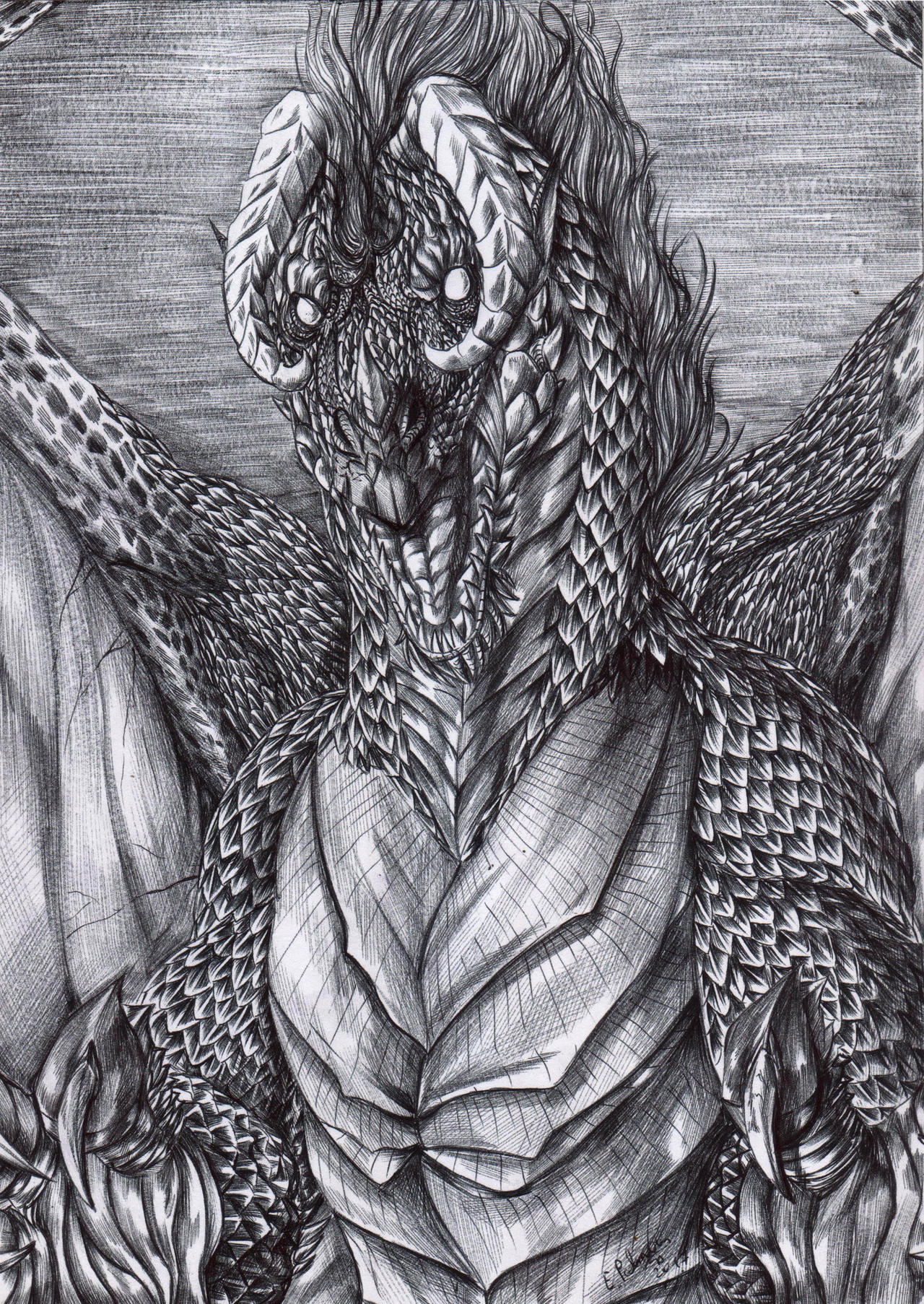
Draghi Oscuri

Draghi Oscuri

(Verusdraco sapiens atra)

Origine
Si tratta di una razza di draghi nata in Germania e relativamente giovane, formatasi con chiari caratteri nel 1331, a seguito di una mutazione spontanea del drago nero (Verusdraco sapiens nigrum) che ha dato vita ad un cucciolo che possedeva innumerevoli caratteri recessivi contemporaneamente. Il primo esemplare di drago oscuro mai nato si chiamava (e si chiama, essendo tutt'ora vivo) Ermes Siegader To'Rvak ed è disgraziamente conosciuto per essere l'autore del Grande Scisma, la separazione delle razze senzienti su questo pianeta e il disconoscimento dell'esistenza dei draghi da parte degli umani. Nonostante queste origini incresciose, non bisogna farsi trarre in inganno dal nome stesso di questa razza: l'unica cosa scura, nel loro intero essere, sono le squame, mentre il carattere è di solito gentile e amorevole.

Aspetto

I draghi oscuri, come il nome rivela, hanno squame nere che possono avere diverse sfumature, dal colore della pece al grigio molto scuro e suddette squame sono conosciute per essere spesse e coriacee, sebbene non tutti gli esemplari possano godere di un'armatura naturale capace di fermare i proiettili. Le corna, rivolte all'indietro nel loro vicino antenato drago nero, sono rigirate in avanti nel drago oscuro e sono costituite da un'impalcatura ossea ricoperta di sostanza cornea di colore dorato-caramello, spesso macchiettate di bruno o di grigio, con nodi vistosi e affilati che danno al corno un aspetto frastagliato. Anche le punte dorsali e gli artigli sono dorati e questi ultimi sono parzialmente retrattili, stretti e più lunghi di quelli dei draghi neri. Situati a sormontare le narici, si possono trovare da uno a due corni conici.
Una delle caratteristiche che permette di distinguere a colpo d'occhio un drago oscuro è la sua criniera, fatta di peli spessi e simile a quella di un cavallo, che protegge la parte centrale e superiore del collo, dove le squame sono naturalmente più rade, e che può avere diverse lunghezze a seconda dell'esemplare.
Le orecchie possiedono un padiglione esterno mobile, appuntito e relativamente piccolo.
Sono draghi di taglia grande e un adulto può pesare fino a cinque tonnellate e mezza di peso, una taglia considerevole se pensate che hanno ossa cave e sacche di aria nel petto, essendo perfettamente atti al volo. L'altezza massima mai registrata da un drago oscuro è di dieci metri e sessantacinque centimetri, con un'apertura alare di oltre venticinque metri! Tuttavia, giunti a queste dimensioni, i draghi oscuri iniziano ad appesantirsi e pur potendo ancora volare, preferiscono rimanere a terra per non sprecare enormi quantità di energia.
La loro coda è potente e mediamente lunga, con la parte finale che si assottiglia e culmina con una punta cornea, anch'essa dorata, estremamente resistente. Un drago particolarmente abile può fare schioccare le coda come se si trattasse di una frusta.

Comportamento
Non ci sono molti dati riguardo al comportamento dei draghi oscuri e Ermes sembra distaccarsi dalla norma della sua specie, mostrante in genere un carattere temperato e solido, gentile, non incline alle nevrosi o alle manipolazioni. Nonostante siano draghi potenti e capaci di utilizzare la magia, non sono soggetti ai tipici complessi di superiorità dei draghi medio-grandi.
Non vivono in branchi anche perché un branco di draghi oscuri divorerebbe tutto il cibo presente nel territorio e sarebbe costretto a spostarsi immediatamente, mentre essi sono stanziali e preferiscono condividere con altre specie molto più piccole i loro rifugi.

Nascita e crescita

Come la maggior parte dei draghi, i cuccioli di oscuro nascono da uova, incubate per un periodo variabile da sette mesi a tre anni. In mancanza di fonti di calore, il cucciolo rimane in stato quiescente finché non viene nuovamente riscaldato e riprende il suo sviluppo; le uova di drago oscuro sono perciò molto semplici da trasportare e da conservare: tutto ciò che necessitano è un luogo freddo, con una temperatura preferibilmente sotto i dieci gradi centigradi. Il guscio dell'uovo è ricoperto di cheratina ed è abbastanza resistente, ma può essere rotto con un pugno ben assestato. Il draghetto non è in grado di rompere da solo il guscio: i genitori devono aiutarlo ad uscire o rischia di morire per anossia.
Alla nascita, un cucciolo di oscuro pesa da 900 grammi a 1,50 kg ed è lungo circa settanta centimetri compresa la coda, ha ali già formate, ma è incapace di volare a causa della debolezza dei muscoli dorsali, che vanno allenati. Le punte dorsali sono appena accennate e le corna corte e tozze, ancora lisce per l'assenza di nodi, mentre gli artigli sono già completamente formati e funzionali.
Il piccolo è fin da subito capace di cacciare e cattura insetti, lucertole e topolini che consuma in grandi quantità, spesso aiutato dalla madre e dal padre che condividono con i piccoli bocconi delle loro prede.
I draghi oscuri sono lentissimi a crescere e raggiungono la piena maturità e la capacità di riprodursi solo superati i vent'anni. Un caso a parte sono i non rari esemplari ermafroditi, come Ermes stesso, la cui maturazione avviene ancora più lentamente rendendoli incapaci di produrre prole fino ai settant'anni di età. La crescita fisica di un drago oscuro continua allo stesso ritmo per i primi cento anni di età, dopodiché rallenta drasticamente senza fermarsi però del tutto.

Vita sociale e corteggiamento
I draghi oscuri, come già accennato, non vivono in branchi, ma ciò non significa che non siano sociali: essi infatti fanno spesso visita ai loro conspecifici che vivono in territori limitrofi e accettano persino nel proprio nido animali di specie diversa, come umani, cani o altri piccoli draghi, di cui si prendono cura.
Talvolta vivono in coppia, sebbene le coppie non siano forzatamente stabili per tutta la vita.
Non esistendo maschi all'interno della razza, ma solo ermafroditi e femmine, il corteggiamento è diverso rispetto a quello di molte altre varietà di draghi: non ci sono infatti ruoli ben predefiniti per un sesso o l'altro ed entrambi i partner si espongono mostrando i propri talenti. Talvolta, i draghi oscuri femmina possono scegliere come partner un drago nero o un altro esemplare del genere Verusdraco, dando origine ad una prole che somiglierà comunque a lei, seppure con caratteristiche minori ereditate dal padre.
Gli esemplari ermafroditi depongono un numero di uova generalmente inferiore a quello delle femmine, essendo queste ultime più grandi e pesanti.
Non esistono periodi specifici in cui i draghi oscuri si riproducono, ma quando una femmina ha dentro di sé uova mature, le ghiandole presenti nella sua gorgiera emettono un odore che richiama i maschi di altre specie e gli ermafroditi di drago oscuro per dichiarare che è pronta ad accoppiarsi. La formazione delle uova dipende da fattori ambientali: quando il cibo è abbondante e nei territori vicini non ci sono altri draghi di taglia grande, la femmina può decidere di dare il via all'inizio della formazione delle uova, che verranno in seguito fecondate da uno o più padri, sebbene sia estremamente raro che una cucciolata appartenga a padri diversi. Le uova sono deposte a circa quarantott'ore di distanza dall'accoppiamento e sono di colore ambrato, ma la superficie si ossida a contatto con l'aria e diviene di un colore che va dal bruno scuro al nero.
Il nido viene costruito da entrambi i genitori ed è generalmente costituito da un'impalcatura di rami e rocce, ricoperta di paglia, erba e pelli e piume di animali che trattengano il calore anche quando uno dei genitori deve assentarsi momentaneamente dalla cova. Sia il padre che la madre riscaldano le uova, dandosi il cambio e usando talvolta il loro respiro infuocato per appiccare letteralmente il fuoco al nido, le cui parti combustibili vengono consumate e successivamente ricambiate, mentre il cerchio di pietre esterno serve da frangifuoco e per il mantenimento del calore.

Habitat e dieta
I draghi oscuri sono distribuiti in quasi tutta Europa e prediligono i boschi folti e in generali i luoghi bui e selvaggi, molto lontani dalle città, in cui possano deporre le loro uova e crescere i loro cuccioli indisturbati. Il territorio di un drago oscuro, o di una coppia, è vasto dagli ottantacinque ai trecento chilometri quadrati.
La loro dieta non è composta di sola carne, come avviene con i più piccoli draghi predatori, ma è ampiamente integrata di frutta, radici e semi. Da giovani hanno bisogno di un maggior apporto di proteine, mentre la sua dieta diventa più bilanciata con l'età: un neonato mangerà il 100% di carne, un giovane esemplare si nutrirà di circa il 40% di vegetali e il 60% di animali, un adulto si ciberà prevalentemente (fin quasi al 75%) di vegetali, con un'importante predilezione per la frutta.
I loro cibi preferiti sono le vespe, gli agrumi in generale e la frutta fermentata. L'alcool su di loro non ha alcun effetto negativo ed essi possono berne in grande quantità e metabolizzarlo tranquillamente come farebbero con l'acqua.
Il loro sistema immunitario è forte, ma non come quello di altri draghi, e non possono mangiare carcasse troppo vecchie.

Draghi oscuri famosi
Ermes Siegader To'rvak
Shadow Ermesson

Curiosità
  • Il primo drago oscuro mai nato era un ermafrodita autosufficiente, cioè capace di deporre uova fertili senza accoppiarsi!
  • Mangiare molto cervello può modificare temporaneamente il loro comportamento, rendendoli meno inibiti come farebbe l'alcool con gli esseri umani.
  • Sono l'unica specie attivamente magica di drago che supera i dieci metri di altezza.
  • Possono avere solo gli occhi verdi, ma possiedono un paio di palpebre protettive (come quelle dei coccodrilli) che può rimanere chiusa e dare all'occhio un aspetto lattiginoso e biancastro.
  • Tutti i draghi oscuri mai nati hanno avuto nomi che gli sono stati assegnati dagli esseri umani e mai da un altro drago.
  • La grandezza delle femmine di drago oscuro è proverbiale. “Spostati, che mi sembri una dragonessa oscura” è un modo di dire piuttosto comune fra i draghi, per esprimere la grossezza di qualcuno che gli ostruisce completamente la visuale.
  • La criniera di un drago oscuro viene definita “capelli”.
 
Galleria d'immagini (Clicca per ingrandire!)


Cucciolo
Cucciolo in gabbia
Con un drago dorato
Giovane affronta gufo mostro
Con dragoniere (Mark McWoodland)
Cuccioli ibridi con drago dorato
By edge-chan


🌵🎨Tutti i disegni in questa pagina (e molto probabilmente anche in tutte le altre pagine, se non diversamente specificato) sono stati realizzati dalle nostre artiste, Furiarossa e Mimma. Potete vedere altri loro lavori e/o supportarle (e supportare così anche tutti i Cactus di Fuoco ;)) sulla loro pagina Patreon. Diventate patroni delle arti!🌵🎨


Lettori fissi